
Aspendos - Far More Than Just an Ancient Theatre
- Written by Portal Editor
Less well known is Aspendos as an ancient Greek city in Pamphylia in Asia Minor, located very close to the theatre near the village of Balkesu or Belkis.
To date, there have been few excavations in the ancient city of Aspendos; all the towering buildings date from the Roman period of the 2nd and 3rd centuries AD, when Aspendos was an important Pamphylian trading centre.
Aspendos Formerly a Port City on the Eurymedon River
 According to Greek tradition, Aspendos was founded around the 12th century BC by settlers from Argos in the Peloponnese. The legendary seer Mopsus, who was also venerated as the city father by cities like Perga, is considered one of the founders.
The Battle of the Eurymedon is documented in literature. As a port city, Aspendos was once connected to the sea by the Eurymedon River (now Köprü Çayı), thus achieving lasting prosperity. In the final battle of the Persian Wars, the Athenian general and naval commander Cimon defeated the Persians there in 466 BC in a double battle on land and sea. Since then, the Eurymedon has politically marked the division between the eastern Persian sphere of influence and Greek Asia Minor to the west. Under Alexander the Great, after initial resistance, Aspendos became tributary. During Roman times, the city was able to establish a predominantly good relationship with Rome and reached its peak as an important trading centre in the region. The export of wine, oil, salt, and horses, in particular, brought Aspendos wealth and prosperity. Aspendos was also the seat of a bishop; the Roman Catholic titular see of Aspendus derives from the diocese.
The best-preserved ancient theatre in the world is still in use today.
 The city had a very eventful history and, over the course of 800 years, was under Lydian, Persian, Greek, Ptolemaic, Seleucid, Roman, Byzantine, and Seljuk rule. During the Byzantine period, the city was called Primoupolis for a time. Little is known of its Greek history – future excavations will certainly shed more light on the pre-Roman era.
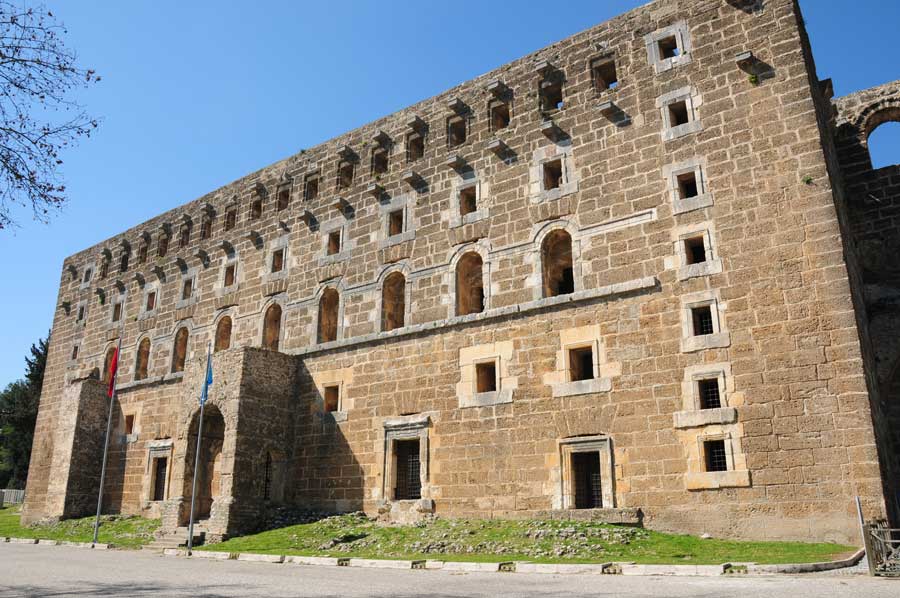
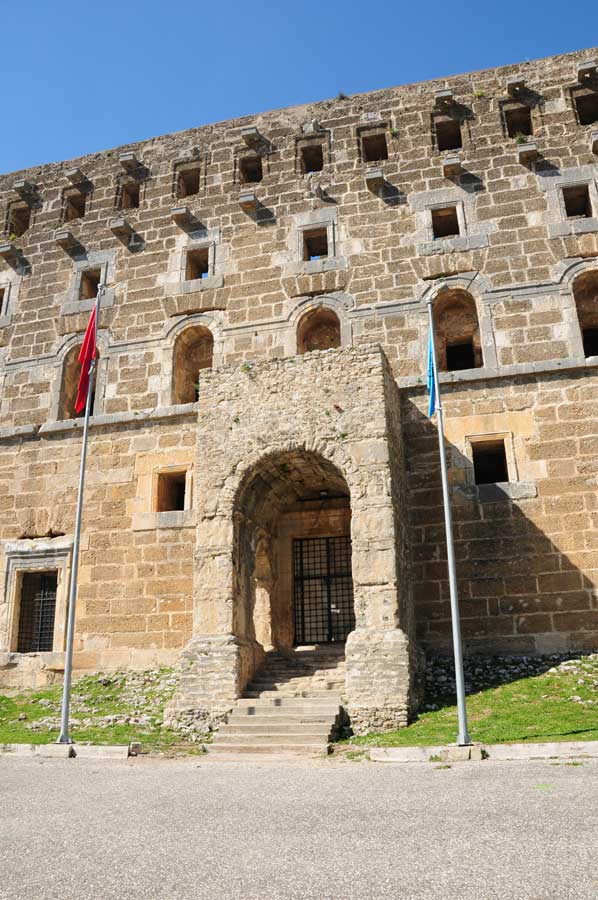
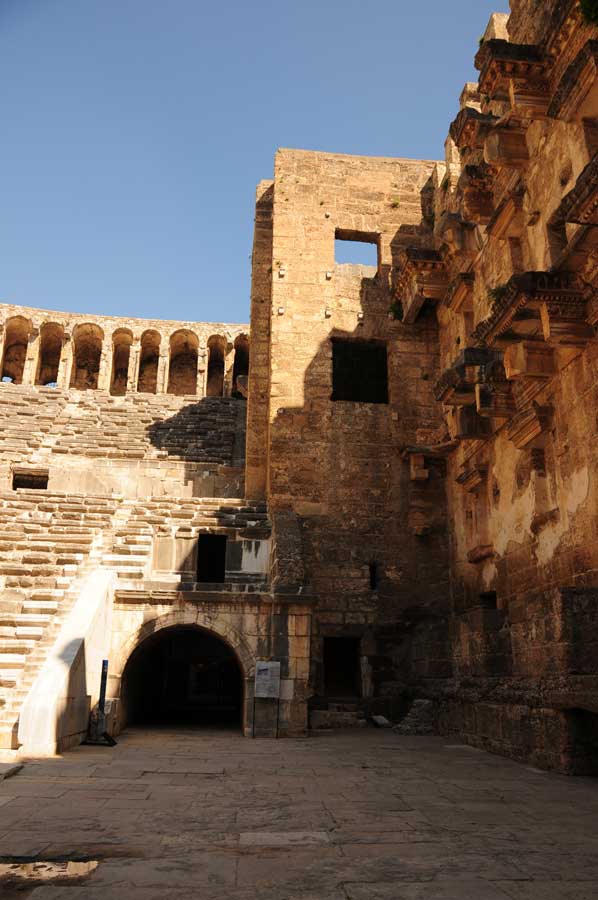
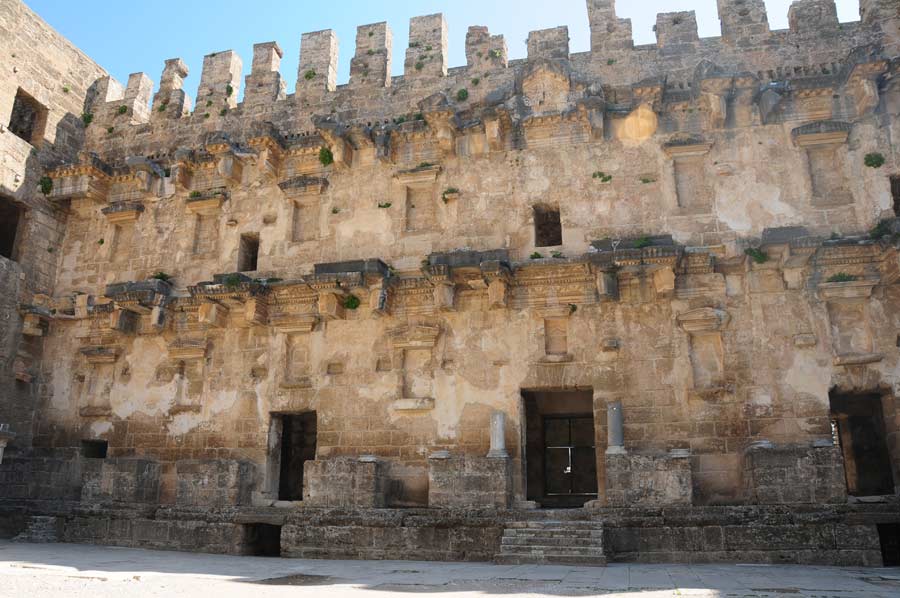
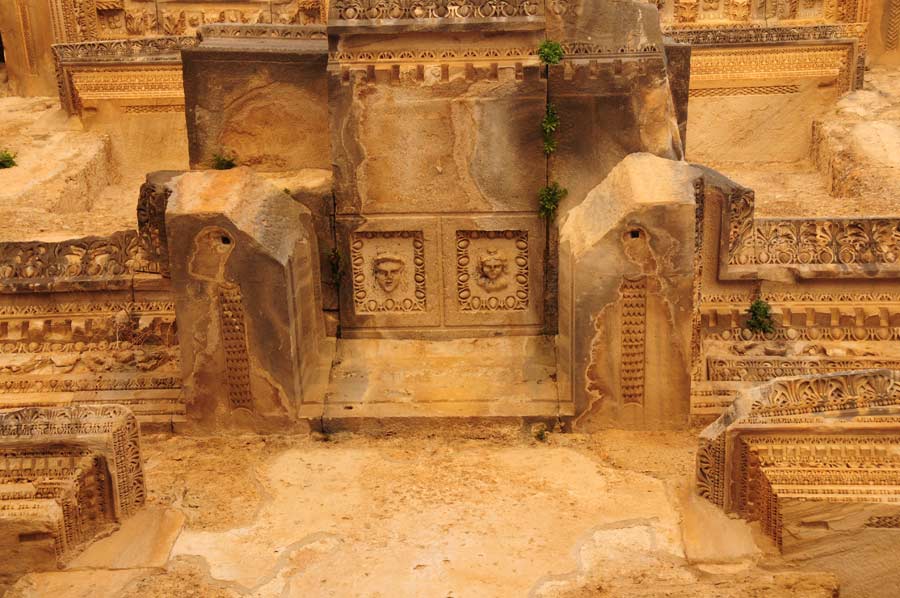
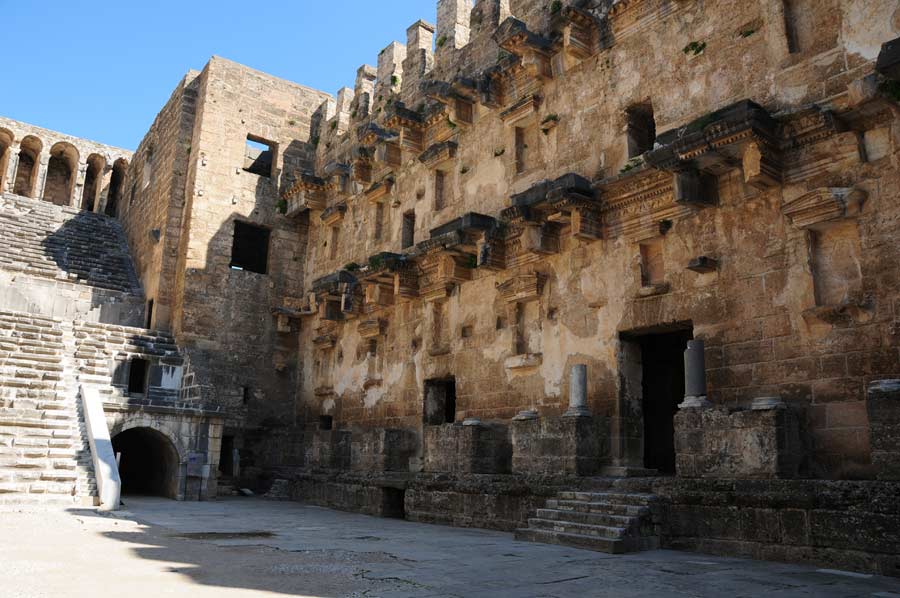
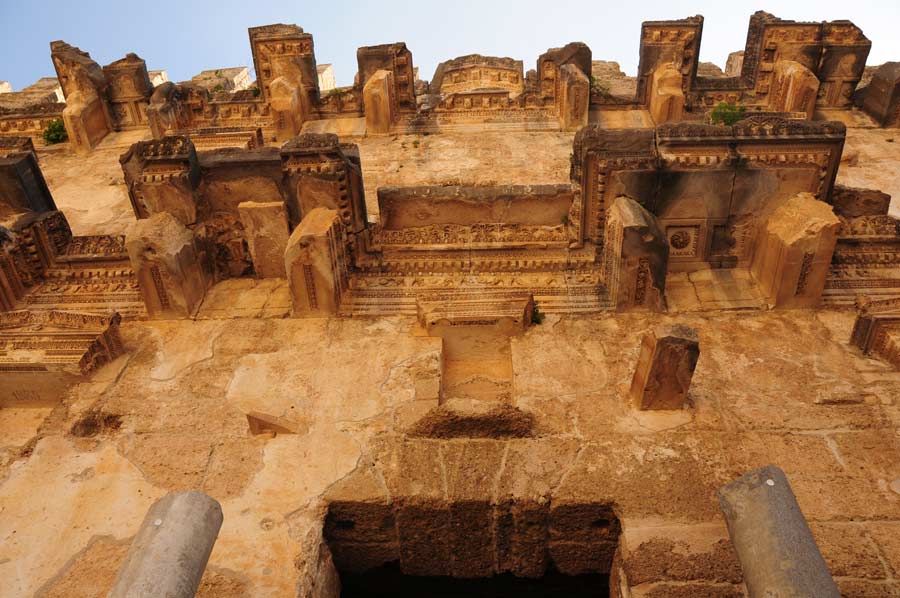
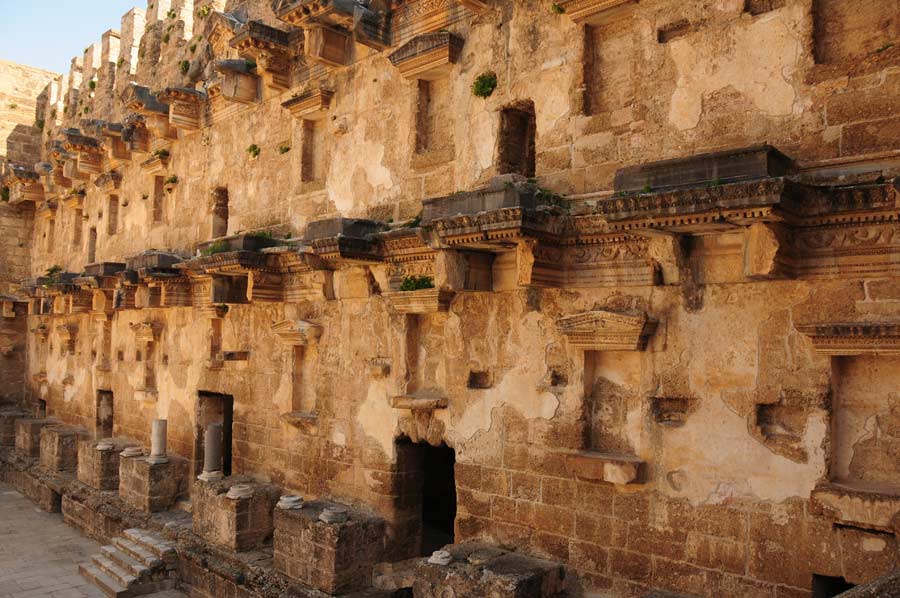
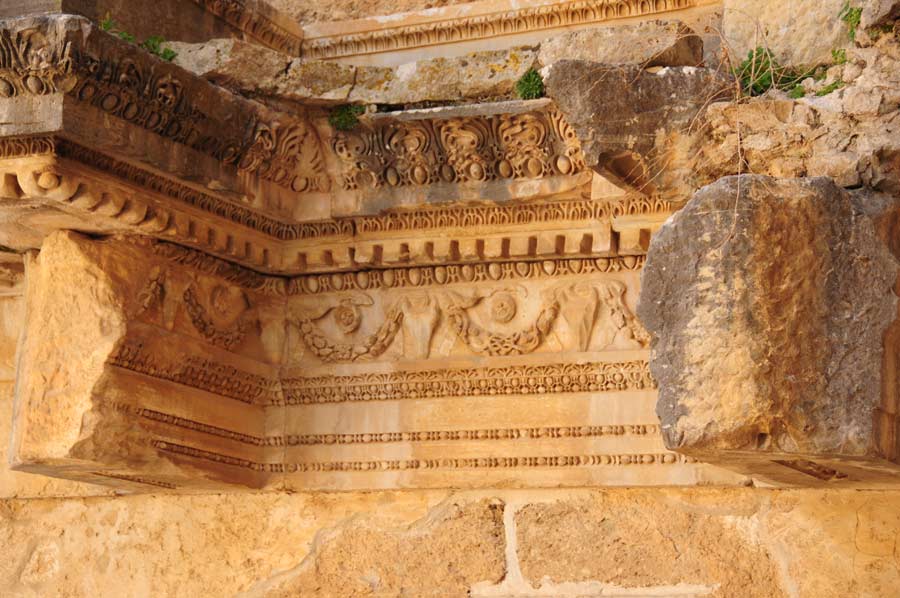
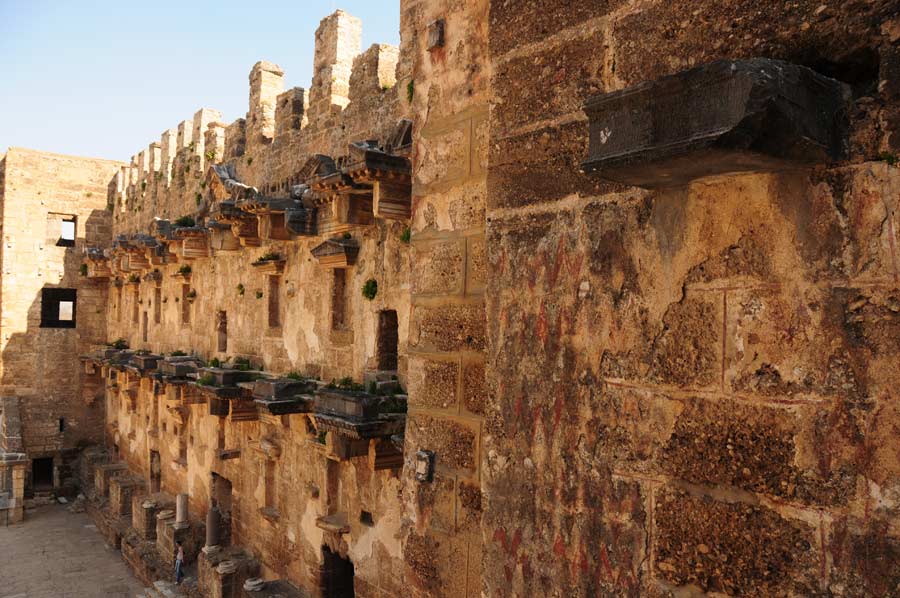
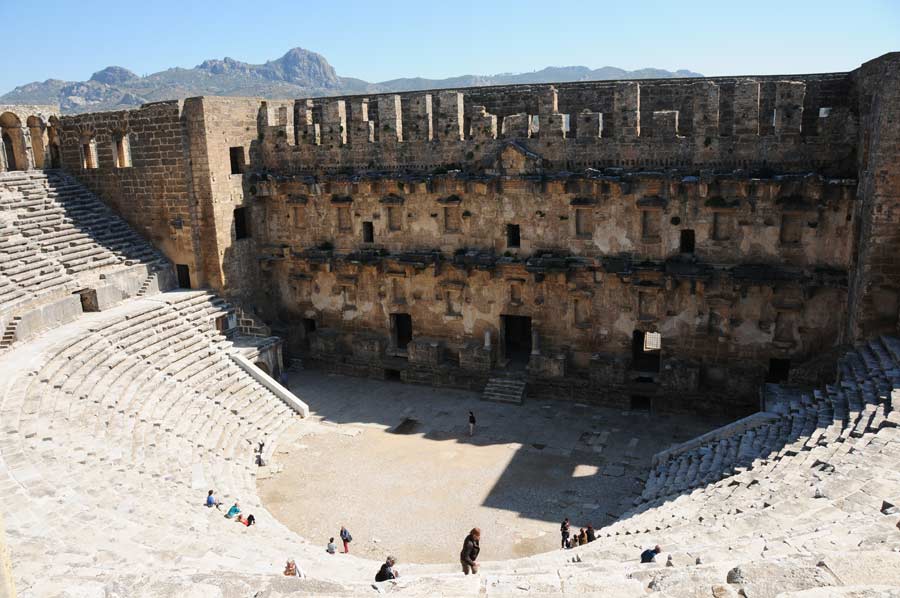
The Theatre of Aspendos is part of the ancient city of Aspendos. The theatre is a Roman building whose stage house has been preserved in its entirety. The interior of the former eight-meter-wide wooden stage was richly decorated with columns, timbers, friezes, rosettes, and ornaments, of which the present-day remains still provide a good impression. The central pediment in the centre of the wall is preserved and features a relief of Dionysus. Below the top of the wall, the recesses on which a sloping wooden structure rested, spanning the stage and providing even better acoustics, are still visible.
Theatre building from the time of Antoninus Pius or Marcus Aurelius
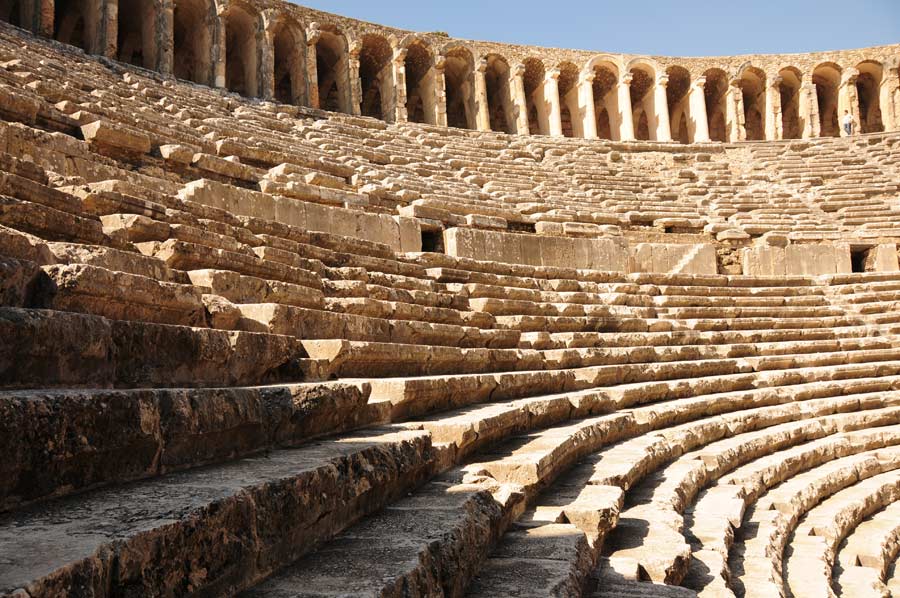
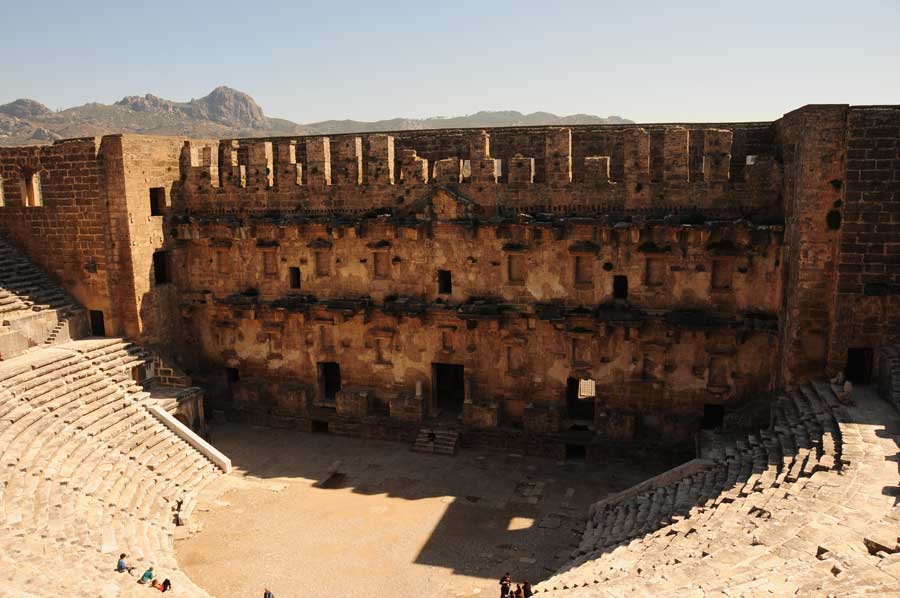 The building was probably built in the 2nd century AD during the reign of Antoninus Pius (138–161) or Marcus Aurelius (161–180). The cavea comprises 39 rows of seats, divided by an aisle (diazoma), and can accommodate 20,000 spectators. Since the Seljuks used the theatre as a caravanserai in the Middle Ages, it was continually repaired and restored after earthquakes. This explains its good state of preservation compared to the surrounding buildings.
The theatre is one of the public buildings in the lower city. Further south are the remains of the thermal baths and the sports complex, the gymnasium. To the northeast is the less well-preserved stadium. To the west of the theatre lies the Acropolis (German: Castle Hill) with the upper city of Aspendos. It was protected by its own wall, and a city gate still stands. In addition to numerous cisterns, the water supply was ensured by an aqueduct, still in excellent condition today, leading from the northern plain to the city.
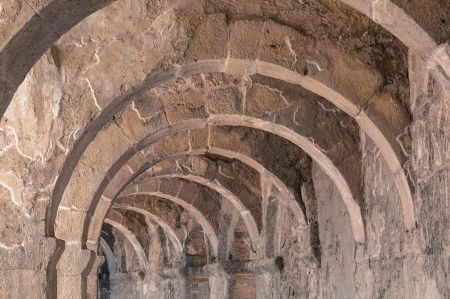
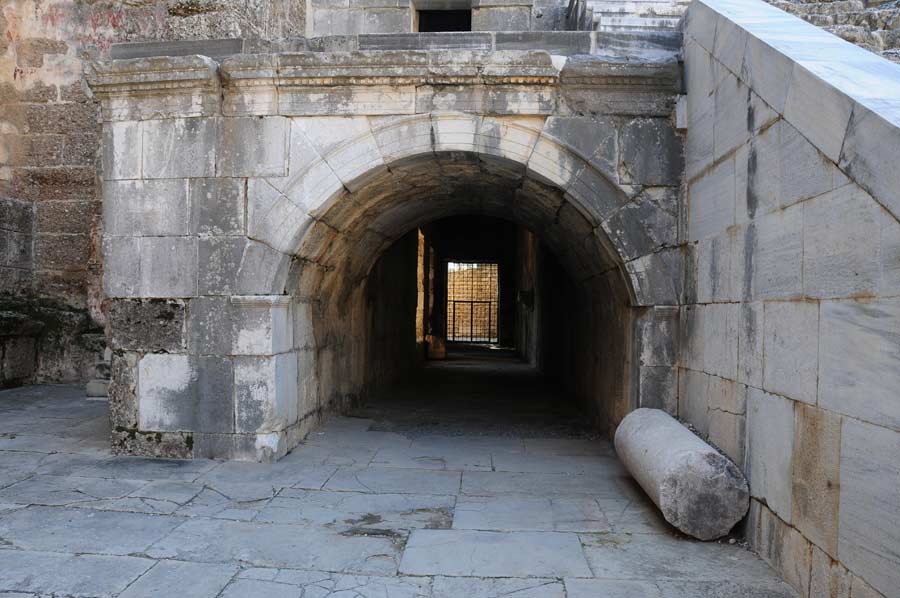
 It seats 20,000 spectators and is known for its excellent acoustics. Even after 2,000 years, the acoustics are so good that a person speaking at a normal volume at one end of the theatre can still be clearly heard at the other end. The Aspendos Theatre is still used today for wrestling matches, concerts, and dance shows. The rows of marble seats, arranged like onion rings, form a perfect semicircle. An open stage, behind it the stage building, magnificent and three-story, in the Corinthian style. Surrounding it is an arcaded gallery – almost intact. The azure sky can be seen in the high arches.
Show events for the audience in an ancient setting
 Aspendos is without a doubt the best-preserved ancient amphitheatre in Asia Minor. Many visitors are initially speechless when the gigantic complex opens up before them. Tour guides besiege the stands, including Zeki, a spirited, curly-haired man from Istanbul. "In the 13th century, the Seljuks converted the theatre into a caravanserai," he explains, "which is why it's so amazingly well preserved." His words immediately climb to the last row of seats; the acoustics in the Aspendos Theatre are truly excellent.
Even today, concerts and ballet performances are regularly held here. Pavarotti, Tarkan, La Triviata... Then cushions are distributed on the stone benches, and all the ice cream and sandwich vendors from the surrounding area arrive. Rapturous applause echoes until late into the night. Event calendars for the season's programs are available in travel agencies and many hotels. If your schedule allows, you should attend an event at the Aspendos Theatre, whether you're a classical music lover or a rock star fan.
One of the major events in Aspendos was the show "Wetten Das" (Wetten Das) with Thomas Gottschalk, which was broadcast live from Turkey for the first time. The dance performance "Fire of Anatolia" is also among the world-famous performances.
Tourists rarely enter the ancient Acropolis Hill at the Aspendos Theatre.
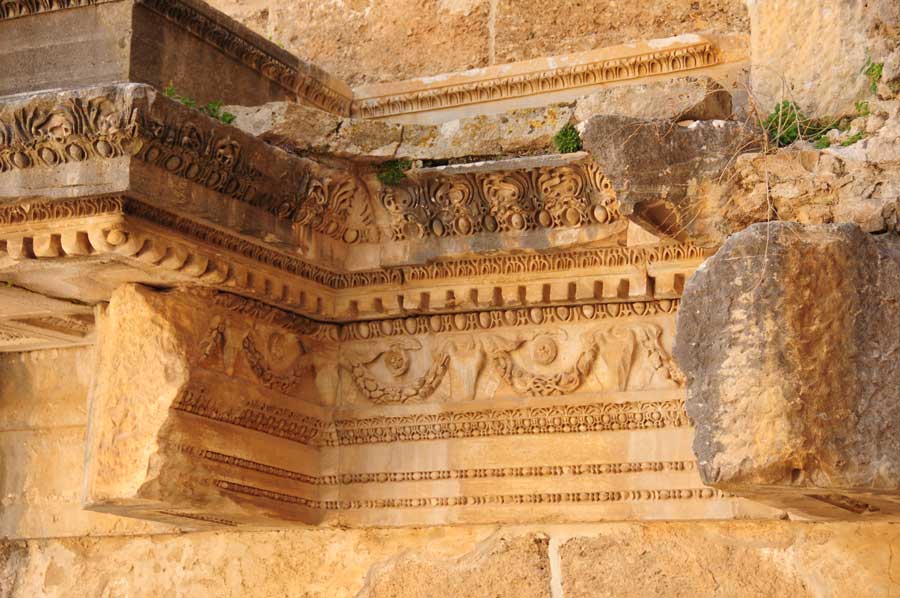 The largely still towering Roman remains on the Acropolis Hill are grouped around a rectangular square on three sides. It is bordered on the western and eastern sides by elongated market halls. The eastern building is 142 meters long, terminates at the southern end with an exedra, and ends at the northern end with a massive, 15-meter-high square structure. The two-story facade of a nymphaeum, which was probably fed by the aqueduct, dominates the north side of the square. Niches for sculptures and projecting cornices for columns and pediments testify to the originally magnificent furnishings. The building behind it at the northwest corner likely served as a bouleuterion (council chamber). The upper town is partially accessible only by stony paths through the bushes and a few signposts, and otherwise largely left to its own devices, leaving the area lushly overgrown. Few tourists make the journey there.
The Theatre of Aspendos – A Masterpiece of Antiquity
Architecture and Construction
 The theatre was built under Emperor Marcus Aurelius (161–180 AD) by the architect Zeno, a son of the city. Its special features:
- Capacity: Approx. 15,000 to 20,000 spectators
• Construction: Semicircular, built into a hill – typically Roman
• Material: Limestone, massive travertine blocks
• Special feature: Almost completely preserved stage house (scaenae frons)
The Acoustics – A Marvel of Engineering
One of the most impressive aspects is the perfect acoustics. Even a whisper on stage can be heard all the way to the upper tiers – without a microphone, without any technical equipment. To this day, concerts, operas, and ballet performances are regularly held here – especially at the famous Aspendos International Opera and Ballet Festival.
The Importance of the Theatre for the Region
The theatre was more than just a place of entertainment – it was a political, religious, and social centre. Here:
- Roman god cults were celebrated
• State proclamations were made
• Philosophers and poets were heard
Aspendos was not just entertainment – it was both education and a display of power.
Other Highlights in Aspendos
 1. The Ancient City

In addition to the theatre, there are many other remains:
- Aqueduct: A technical masterpiece of Roman hydraulic engineering
• Stadium, agora, basilica, and thermal baths – some of which are clearly visible
• City walls and gates
2. The Aspendos Aqueduct
Another highlight is the aqueduct, which carried fresh water 15 km into the city. The structure, with its siphon-like pressure pipes, is an example of Roman engineering at its finest.
A Place of Legends
The construction of the theatre is surrounded by a legend: Two brothers wanted to marry the daughter of the King of Aspendos. One built the theatre, the other the aqueduct. The king was so impressed by the theatre—especially its acoustics—that he preferred it. The aqueduct's brother threw himself to his death in despair. Tragic—but testifies to the theatre's importance to this day.
Modern Use—An Ancient Stage for Timeless Art
 The theatre lives on today—not as a museum, but as a vibrant cultural centre. Every year, the internationally renowned Aspendos Festival takes place here, where:
- World-famous opera stars perform
• Classical music blends with Roman flair
• Ballet performances take on a new depth
A visit at night, when the stage is atmospherically lit, is unforgettable.
Arrival & Visit Tips
- Address: Belkıs Köyü, Serik, Antalya
• Getting there:
o Rental car or excursion bus from Antalya
o Combined tours with Side or Perge can be booked
• Admission: Approx. 8–10 euros, combined ticket with aqueduct recommended
• Opening hours: Daily, usually 8 a.m.–5 p.m. (longer in summer)
• Tip: Visit early in the morning or late in the afternoon – less hot, better light
Photography and travel tips
- Best time to photograph: Golden hour (shortly after sunrise or before sunset)
• Lenses: Wide-angle for a view of the stage, telephoto for details of the friezes
• Clothing: Sturdy shoes, sun hat, bring water – the terrain is uneven!
Why Aspendos is a must-see
 There are many ancient sites in Turkey – but none like Aspendos. It is not just preserved – it lives on. The place combines history, music, architecture, and emotions into a deeply moving experience. Anyone who has ever sat on these stones will feel why Roman culture never completely disappeared.
Conclusion
Aspendos is more than a destination – it's a journey into the soul of an ancient civilization. A place where past and present come alive in every note, every stone, and every shadow on the stage. Anyone visiting the Turkish Riviera shouldn't miss this magical place.
Frequently Asked Questions (FAQ)
1. How long does a visit to Aspendos take?
At least 1–2 hours, with a city tour, up to half a day.
2. Is there parking?
Yes, directly in front of the entrance – for a fee.
3. Can I take guided tours?
Yes, book on-site or in advance. Many operators in Antalya offer guided tours.
4. Is the area wheelchair accessible?
Partially – the theatre is accessible via stairs, but there are level paths around the outside.
5. When do events take place?
Usually in summer – festival information can be found on the official website or from the city of Antalya.
Please read as well:
Ücagiz and Theimiussa in Kekova Region
The Mediterranean Village Kaleköy and ancient Simena
-
 Aspendos beautiful ancient Theatre
Aspendos beautiful ancient Theatre
Aspendos beautiful ancient Theatre
-
Aspendos beautiful ancient Theatre
Aspendos beautiful ancient Theatre
-
Aspendos beautiful ancient Theatre
Aspendos beautiful ancient Theatre
-
Aspendos beautiful ancient Theatre
Aspendos beautiful ancient Theatre
-
Aspendos beautiful ancient Theatre
Aspendos beautiful ancient Theatre
-
Aspendos beautiful ancient Theatre
Aspendos beautiful ancient Theatre
-
Aspendos beautiful ancient Theatre
Aspendos beautiful ancient Theatre
-
Aspendos beautiful ancient Theatre
Aspendos beautiful ancient Theatre
-
Aspendos beautiful ancient Theatre
Aspendos beautiful ancient Theatre
-
Aspendos beautiful ancient Theatre
Aspendos beautiful ancient Theatre
-
Aspendos beautiful ancient Theatre
Aspendos beautiful ancient Theatre
-
Aspendos beautiful ancient Theatre
Aspendos beautiful ancient Theatre
https://www.alaturka.info/en/turkey-country/riviera/2214-aspendos-antalya?layout=default&print=1&tmpl=component#sigProIde2c4f80ed2