David Abulafia – Presentation of "The Mediterranean"

Today, we begin a series as previously announced in which Christian Röhrl will present various contemporary books for the “Alaturka Journal”. We hope you enjoy the read!
Dear readers of the “Alaturka” portal,
My name is Christian Röhrl, an independent bookseller from Regensburg. I first encountered the team behind the cultural portal www.alaturka.info during the German-Turkish Friendship Festival in Izmir.
The portal already offers a wealth of content for anyone interested in Turkey and culture in general.
However, I felt there was still room to expand into the realm of literature a gap I intend to fill with my book reviews.
When the three-year project, "A Journey of Understanding and Culture Along the Roman Roads," was introduced to me, the idea for this literary segment took shape. It will be developed into three distinct categories:
1) Books on European culture,
2) Travel books about Turkey,
3) Literary encounters between German and Turkish authors.
The latter will eventually find a home at a German-Turkish literature festival in Regensburg.
I hope this initiative leads to many engaging readings, meaningful encounters, and friendships that bridge our two cultures.
While I was developing these ideas, I came across the following non-fiction book and I knew immediately that I had found the perfect starting point for this series:
David Abulafia “The Mediterranean”
1) Commentary by Chris Röhrl:
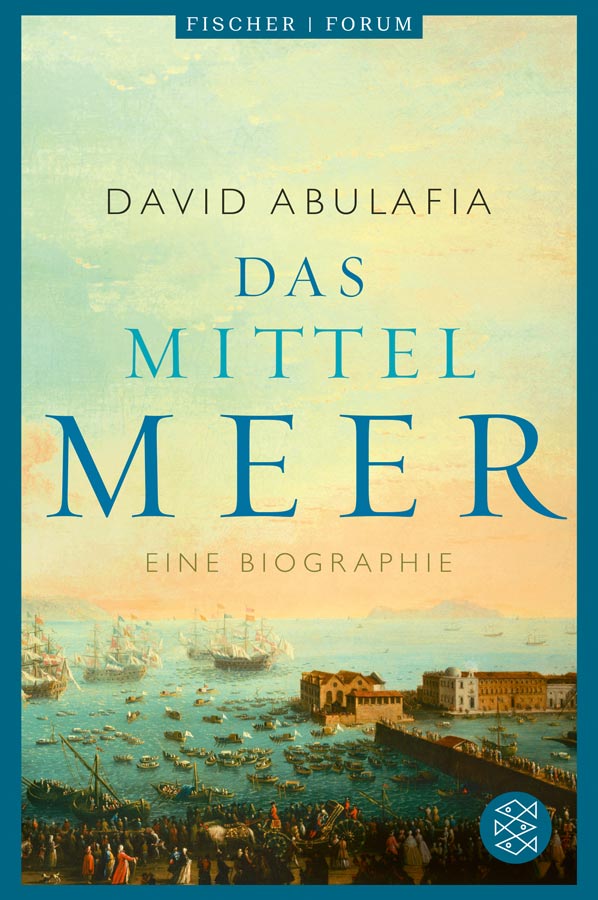 Reviewing this book proved challenging precisely because of its exceptional quality. Once I began reading, it captivated me so completely that I found it difficult to pause even to take the notes necessary for this review. I have included the official content summary and blurb below. I believe that a good book always leaves the reader changed different from the person they were before they began reading. This may sound high-flown, but in my view, it is what distinguishes good literature from mere entertainment. With entertainment, one simply kills time albeit often in a pleasant way whereas good literature makes the time spent richer. I have read many books about antiquity, as well as Greek and Roman history; ever since my first Latin lesson, I have been captivated by this world a world that seems so distant, yet continues to exert such a profound influence to this day. The role the Mediterranean played both as a medium connecting cultures and peoples, and as a theatre of war is brought to life so vividly that one can easily understand why the author refers to this work as a "biography" of the Mediterranean.
Despite all the descriptions I had encountered previously, I still found it difficult to imagine how people over 2,000 years ago managed to bring such vast territories the entire Mediterranean region under their control; how culture, discoveries, products, and inventions could spread with such astonishing speed; and how everything evolved from East to West, eventually circling the entire region and beyond. Everything here is presented with an unparalleled clarity. I find the passages describing the tiny geographical distances specifically where the paths of the Latin and Greek alphabets diverged particularly fascinating. The divide lay between the elongated island of Euboea and the Attic mainland separated by only a narrow strip of water yet it had, and continues to have, a massive cultural impact on countless people to this day. As Spock would say: "Fascinating." Many well-known conflicts are illuminated with such clarity that one can suddenly make sense of even the most convoluted courses of war such as those between the Greeks and the Persians, the 145-year-long Punic Wars, or the bewildering civil wars that preceded the establishment of the first Roman Empire.
I can tell I’m getting carried away by my own enthusiasm again.
Incidentally, we are currently a long way from the "Mare Nostrum"—as it was called in Roman times. The conflicts of recent decades have tended to lead in the opposite direction: toward fragmentation and division.
In its current literary magazine, “Die Zeit” asks the author:
"You dedicated your book to your ancestors. Why?"
Abulafia:
"Because they embody this very cosmopolitan world a world that, time and again, they saw fall into decline. There were prominent Abulafias in Christian Spain, including Don Samuel Abulafia, who commissioned the construction of a synagogue in Toledo that still stands today. Following the expulsion of the Jews from Spain, some of my ancestors settled in Italy—where their descendants often bear the name Bulaffi or Bolaffio. Others returned to the Holy Land, to Safed in Galilee. One of them was even involved in the founding of Tel Aviv."
Abulafia himself lives in rainy Cambridge, finding there the very blend of cultures, perspectives, and identities that he believes has been lost in the Mediterranean region.
In short, I cannot recommend this book highly enough "here I stand, I can do no other."
Yours, Chris Röhrl, from the “Bücherwurm” bookstore in Regensburg.
2) Publisher Information
EAN: 9783100009043 | Translated by Michael Bischoff | Publisher: S. Fischer
Hardcover – 959 pages | A biography. Original title: “Mediterranean”.
Hardcover | 34.00 EUR
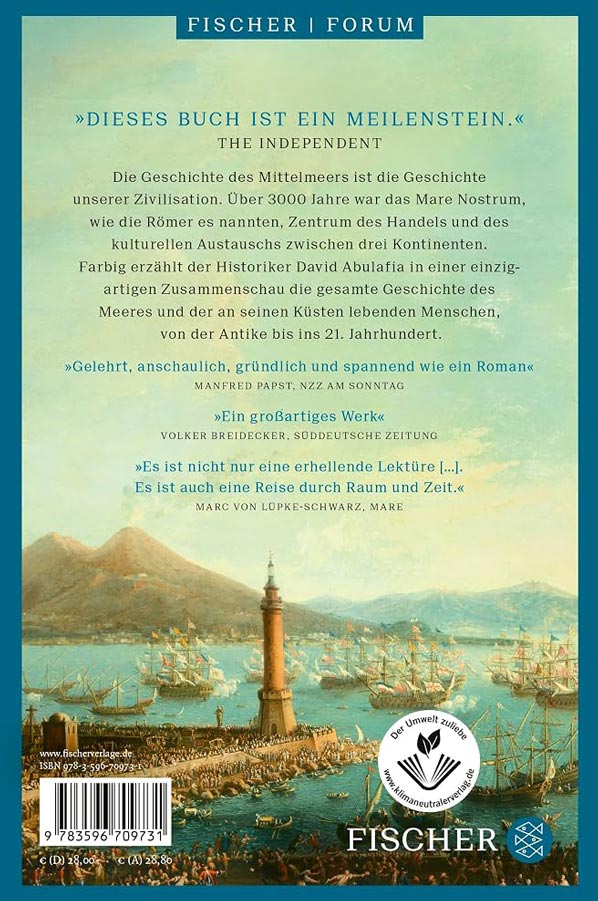 The history of the Mediterranean is the history of our civilization. A magnificent, opulent work on the history of the Mediterranean for more than 3,000 years, the Mediterranean has been one of the centres of the civilized world. Along its geographical axis dating back as far as the time of Troy political and cultural innovations of global significance have taken shape. From this region, new empires were conquered, borders redrawn, and worldviews imposed; it has been a theatre of epic voyages, horrors, wars, feuds, sieges, and tragedies. Yet, there is another side to this story: an unparalleled history of dialogue between diverse cultures, identities, political systems, scientific traditions, trade networks, and religions along the shores of this sea a body of water for which the Romans had a single, all-encompassing name: “Mare Nostrum”.
Abulafia spans both space and time, revealing how the Mediterranean became a powerful nexus where the history of humanity is reflected in a unique way. A sensational work, featuring an extensive section of colour illustrations.
Praise:
"A learned history of humanity, told through the lens of the Mediterranean gripping, expansive, bloody, and vibrant that captivates through its scholarship, enthusiasm, and capacity for wonder." Simon Sebag Montefiore, author of “Jerusalem”
"This book will remain unrivaled for a long time to come." “Literary Review”
"This book is a milestone." The Independent
"The sheer range of Abulafia’s knowledge is almost uncanny." Observer
"This epic, highly readable, and scholarly work on the birthplace of the West the Mediterranean is a prime candidate for history book of the year." "Abulafia outshines them all." Sunday Times
David Abulafia, born in 1949, is Professor of Mediterranean History at the University of Cambridge, and a Fellow of Gonville and Caius College and the British Academy.
He is also a member of the Academia Europaea.
For his work on Italian and Mediterranean history, he was named a “Commendatore dell’Ordine della Stella della Solidarietà Italiana” in 2003.
He has published numerous books, including “The Discovery of Mankind: Atlantic Encounters in the Age of Columbus” and “The Mediterranean in History”.
“The Mediterranean” has been translated into many languages and has received several awards, including the Mountbatten Award for Literary Excellence.
David Abulafia / The Mediterranean