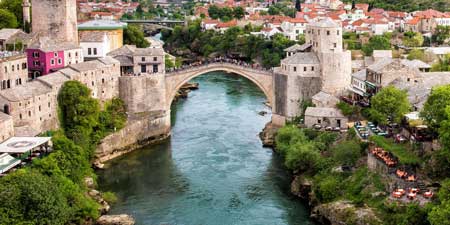
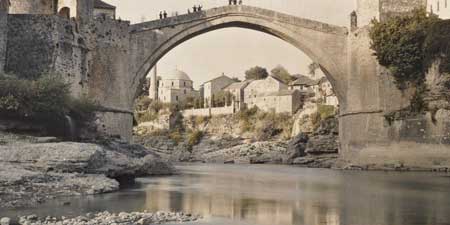
Bosnia and Herzegovina - much more than just Stari Most
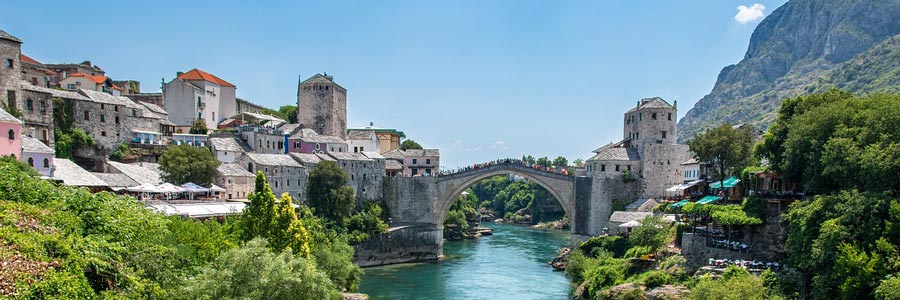
Bosnia and Herzegovina consist of two historical regions, which bear no relation to the current division into entities: Bosnia and Herzegovina. The country's name, Bosnia, is derived from the Bosna River, which originates near the capital, Sarajevo.
Sarajevo and the surrounding area are home to numerous sights. The Latin Bridge, for example, was the starting point of the First World War, as it was here that the assassination attempt on Franz Ferdinand of Austria and his wife took place.
Also worth seeing are the entire old town of Baščaršija, with the Turkish water fountain Sebilj, and the Vijećnica, the city's old town hall.
Other attractions include the castle and fortress walls of Počitelj, the medieval castle of Travnik, the fortifications and Amphitheatre of Banja Luka, the lakes Blidinjsko jezero, Prokoško jezero and Šatorsko jezero, numerous medieval tombstones (stećci), especially in Herzegovina, rafting opportunities on the rivers Neretva, Una, Vrbas and Drina, and the Adriatic coastal town of Neum, which has the highest average annual temperature in the country.