Gödens - Moated Castle and Settler´s of Neustadtgödens
- Written by Portal Editor
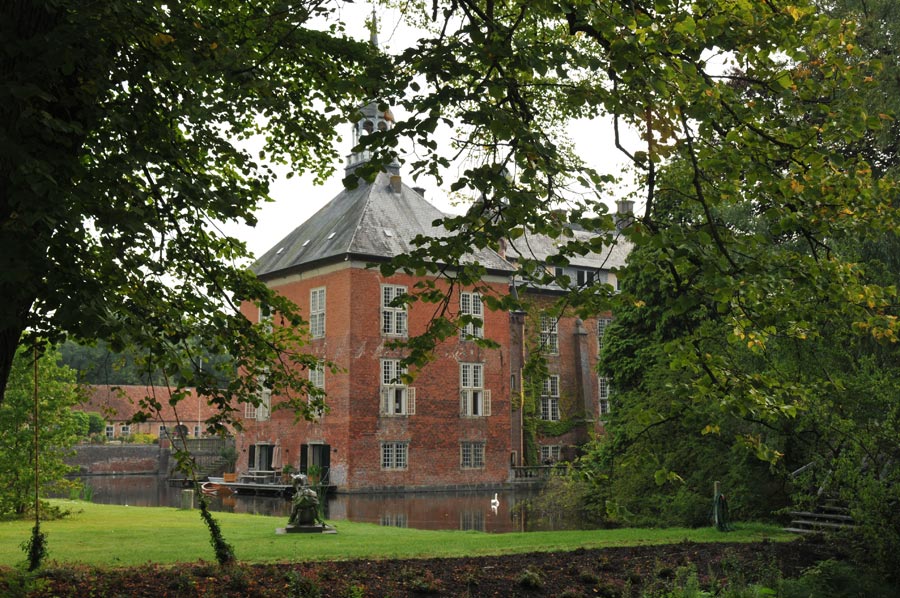
Gödens - Once again, we were traveling in northern Germany, as the long-standing town festival in Oldenburg had invited us to visit and report on it, a wish we would like to fulfil later.
We also wanted to use our time in the north to visit a few other destinations we hadn't been able to visit yet. These included the moated castle in Gödens as well as the town of Neustadtgödens, once voted the most beautiful village in Lower Saxony.
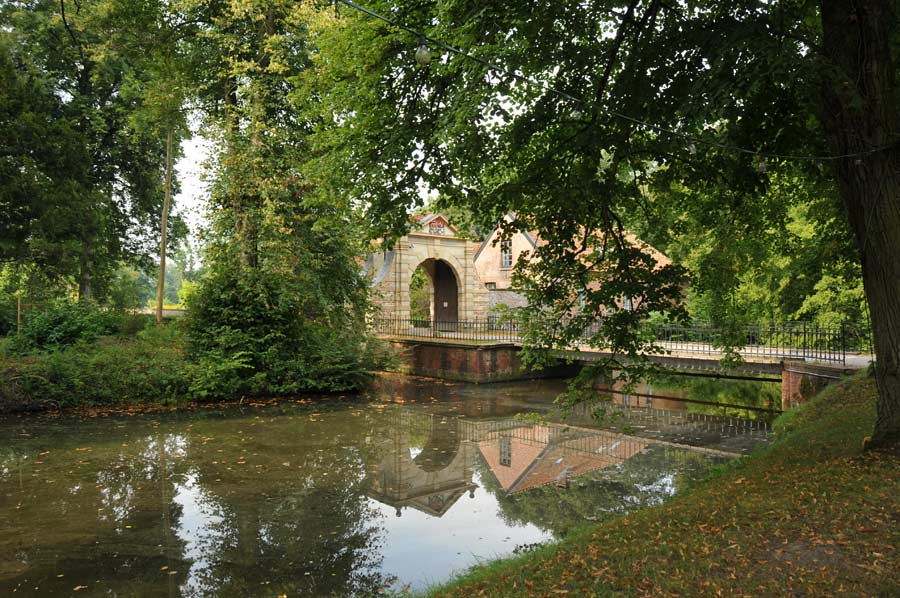
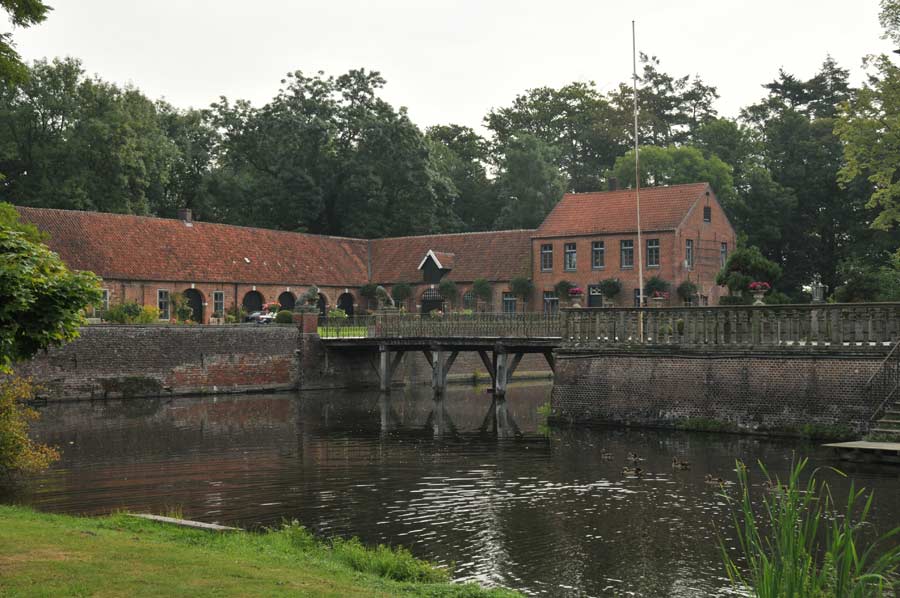
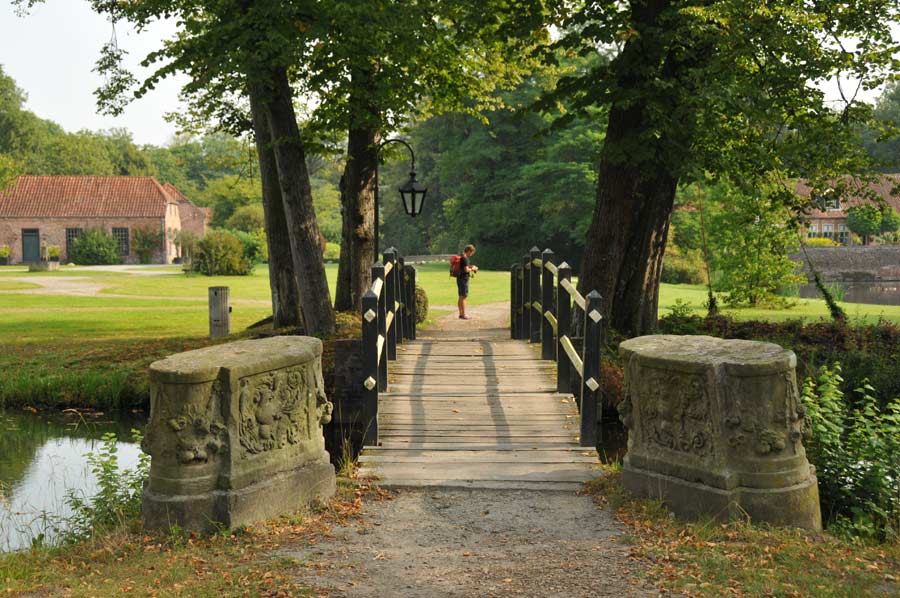
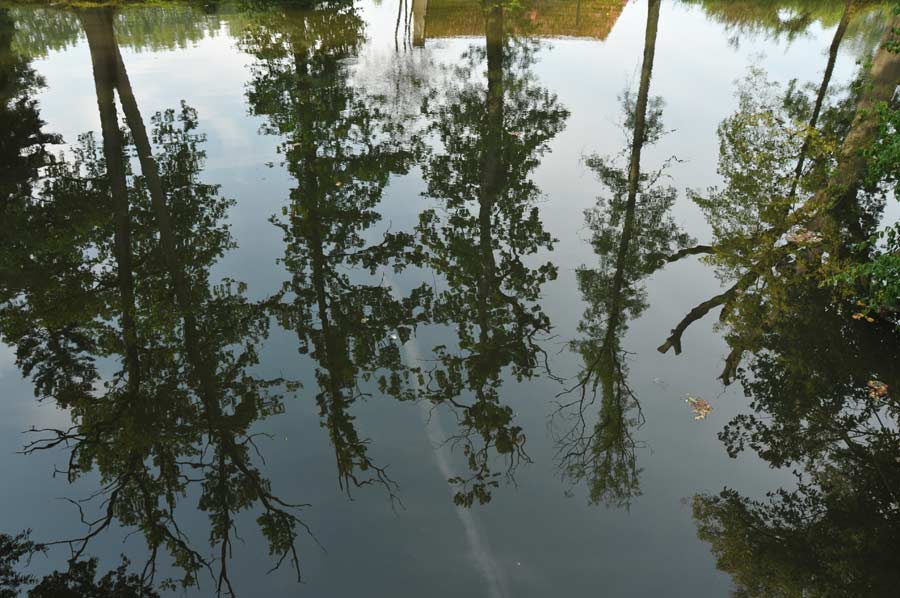
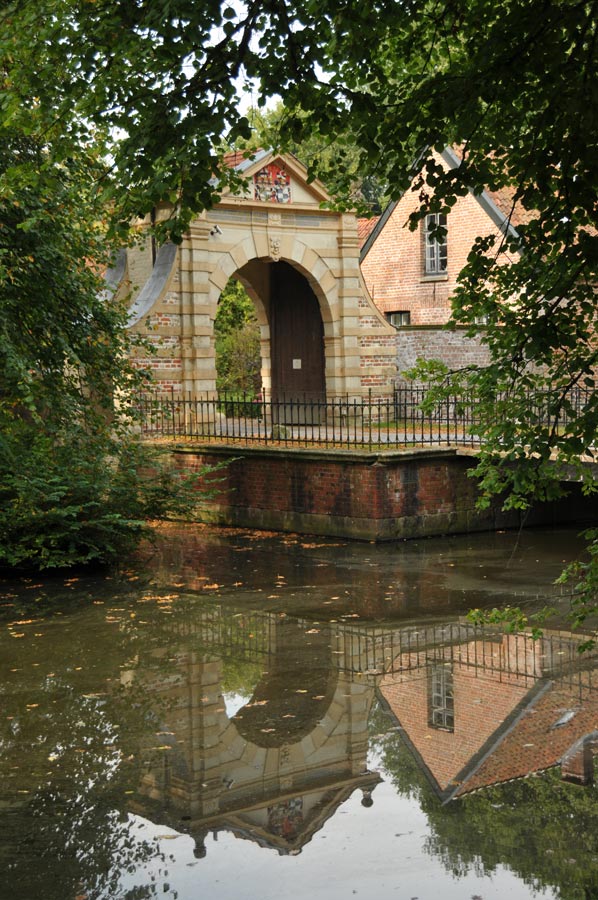 We drove along the A29 motorway to the Sande/Neustadtgödens exit, where we turned onto Landstrasse 436 towards Friedeburg. Immediately after leaving the motorway, the town of Neustadtgödens is on the left, but we only passed through it at first, as Gödens Castle was our first destination of the day. A little later, we turned right onto County Road 96 towards Dykhausen, which runs along the castle gardens. After parking the vehicle, we first passed the tree-lined avenue that runs along the outer moat of the moated castle complex. This provided the first photo opportunities, as both the entrance gate and the tall trees were beautifully reflected in the water of the moat.
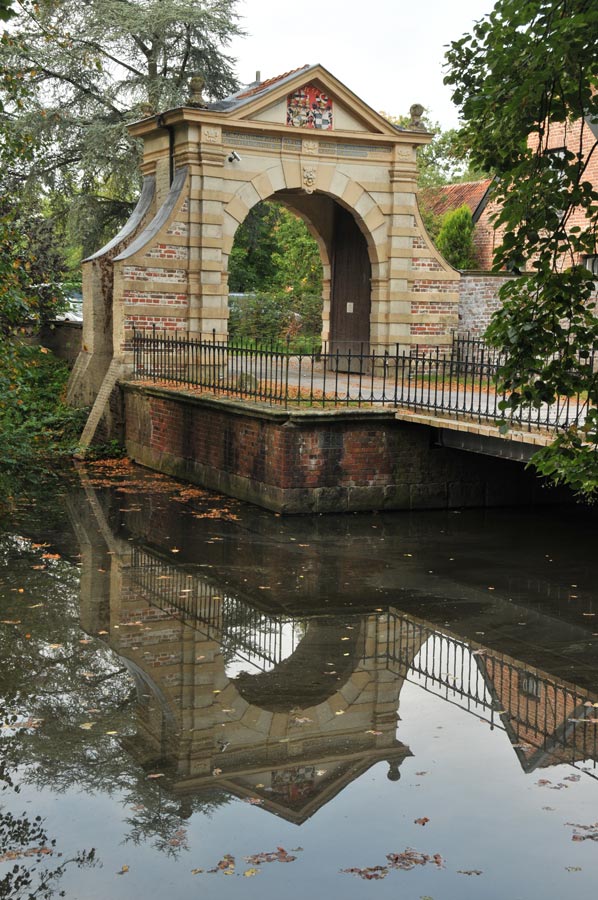
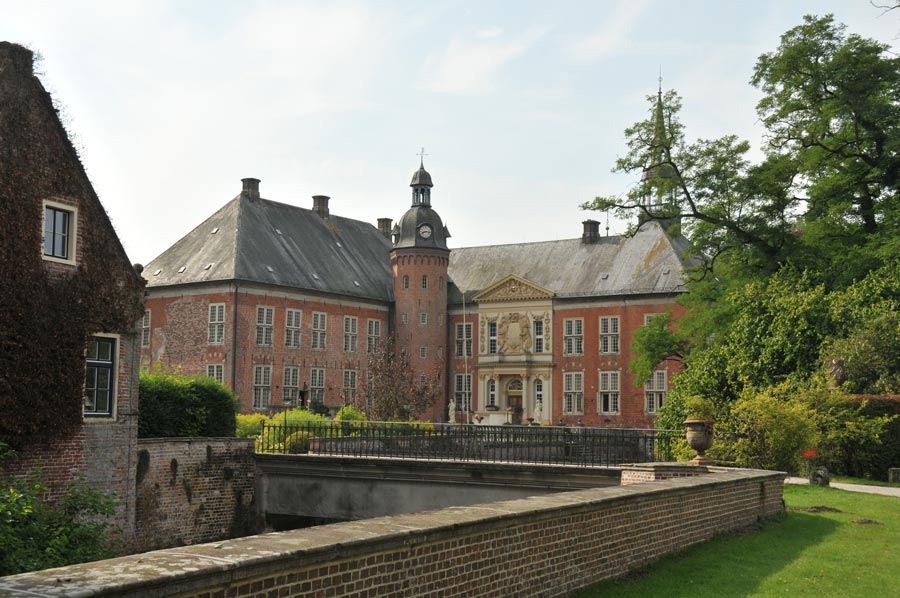
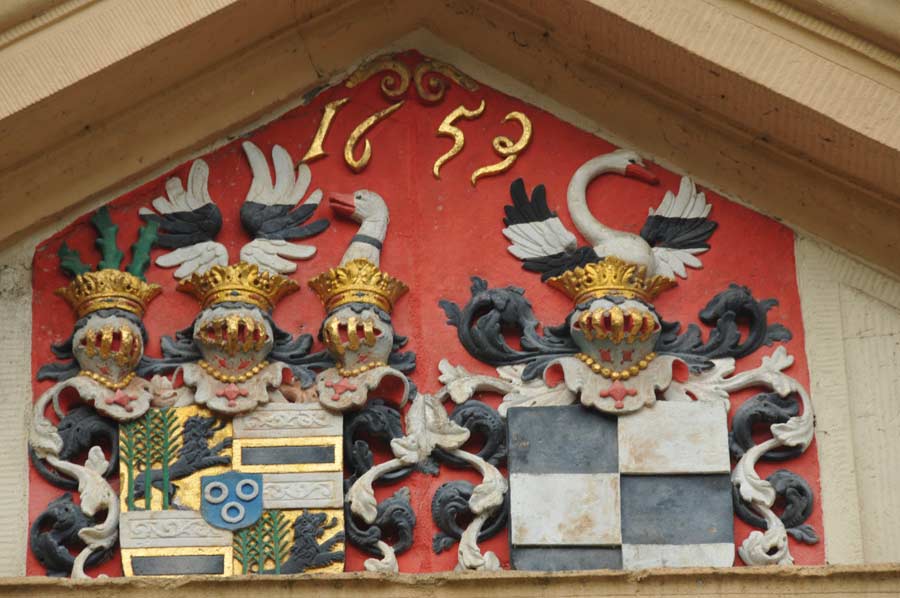
We entered the large castle garden through the imposing entrance gate, which, in addition to the coats of arms of the noble residents, also features several inscriptions dating back to 1653. From our research, we know that there must have been predecessor buildings to the present castle at that time, but they burned down in a great fire in 1669. The nobleman Harro Burchard von Frydag then had the moated castle built in its current form in 1671. Through marriage, Gödens Castle then came into the possession of the von Wedel family in 1746.
 The Wedel family first appears in documents in 1212 with Heinricus, Hasso, and Reimbernus de Wedele, and traces its lineage back to the monastic bailiff Heinrich, bailiff of the "Novum Monasterium" monastery (Neumünster), who was mentioned on September 13, 1149, in Ottenbüttel (Steinburg district, Schleswig-Holstein). In December 1302, the brothers Heinrich, Johannes, and Reinbert documented that their uncle Reinhard the Elder sold the village of Spitzerdorf to the Hamburg cathedral chapter in their presence and with their consent. Three brothers of the family also appear as witnesses in a document by Heinrich von Barmstede in 1212. A member of the family was captured as a ringleader after the Second Battle of Uetersen in 1306 and publicly broken on the wheel and quartered. The family has had a castle in Pomerania since 1240 and consists of three branches. In 1328, Emperor Ludwig is said to have granted the towns and castles of Küstrin, Falkenburg, Schievelbein, Neu-Wedel, Kallies, Reetz, Nörenberg, Hochzeit, Klein-Mellen, and Berneuchen to the Lords of Wedel as fiefs. From 1444 to 1445, Hans von Wedel served as a diplomatic negotiator between the Teutonic Order and the Kingdom of Poland.
 A branch of the family had been based in East Frisia since the early 18th century. The von Wedel family owned the lordship of Loga, now a district of Leer. There, among other things, they had the Evenburg remodeled and the Philippsburg built. This line of counts (Gödens-Evenburg) held a hereditary seat in the Prussian dynasty from December 5, 1867, until the revolution of 1918. 78 family members joined the National Socialist German Workers' Party (NSDAP) during the Third Reich, 35 of them even before the seizure of power (taken from Wikipedia).
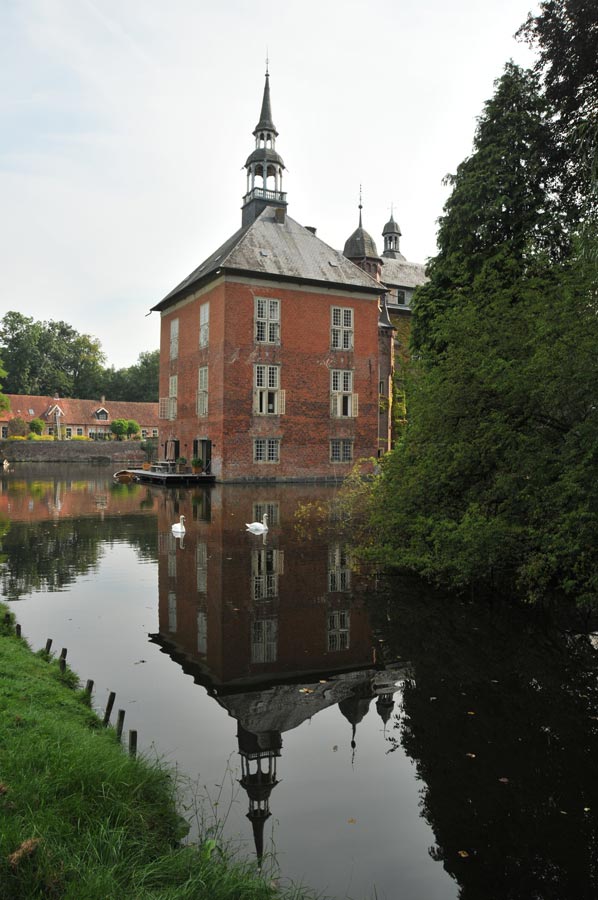
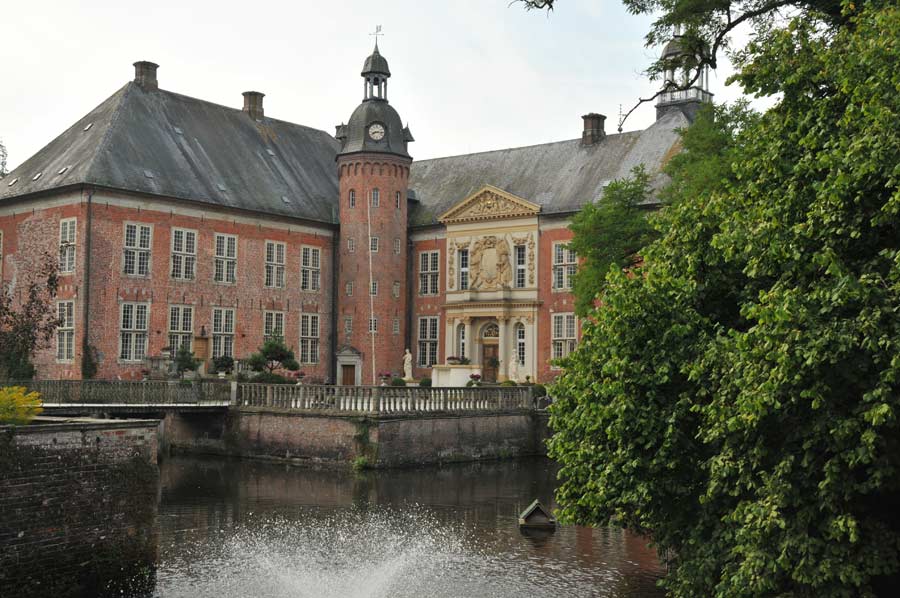
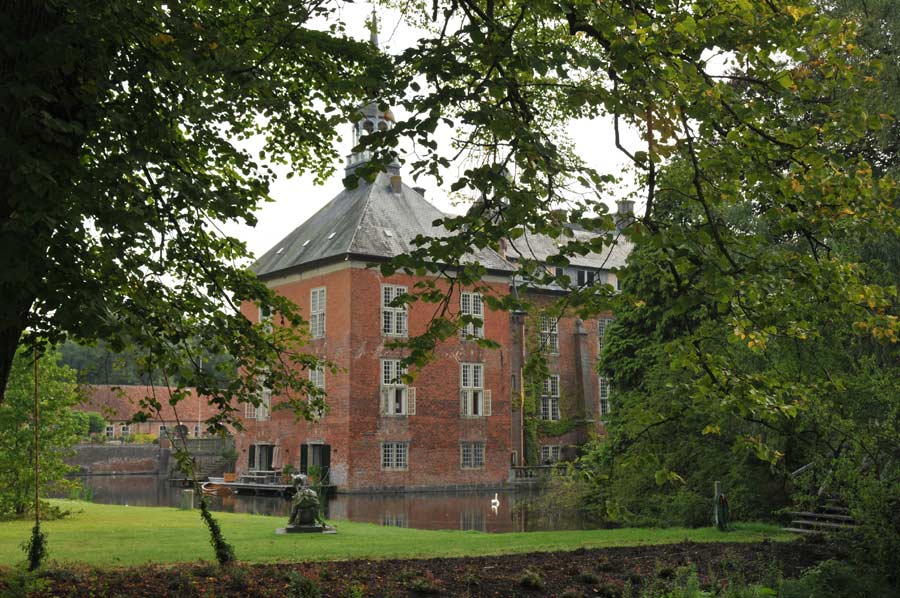
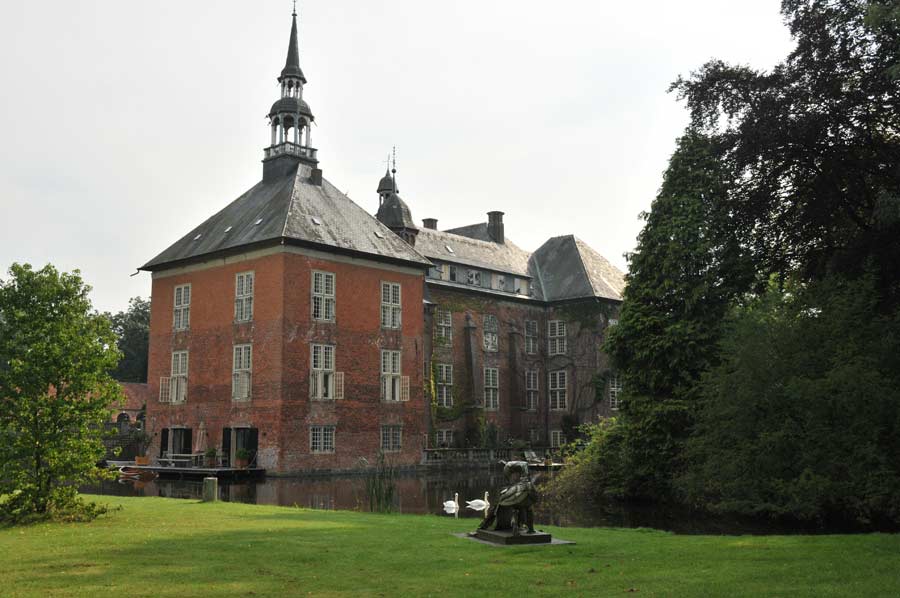
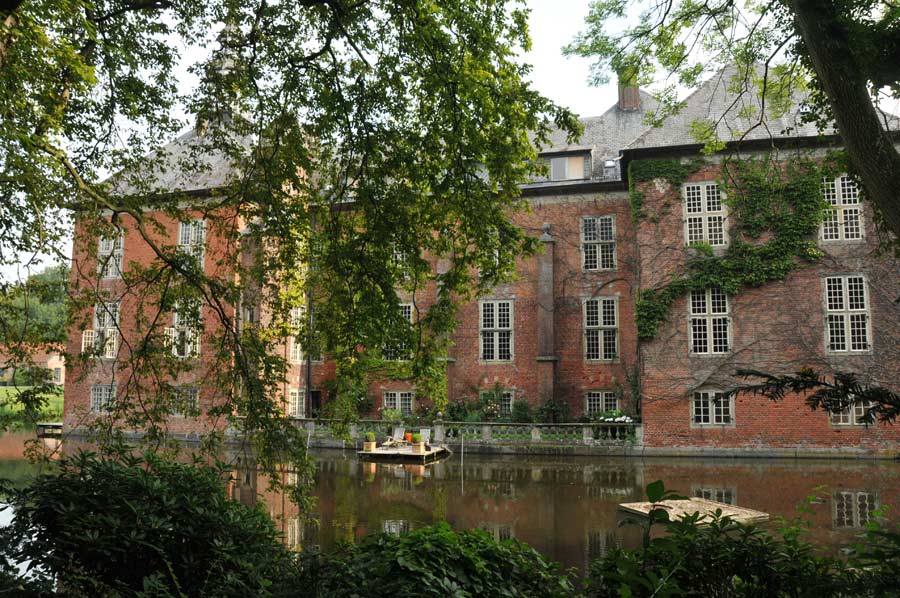
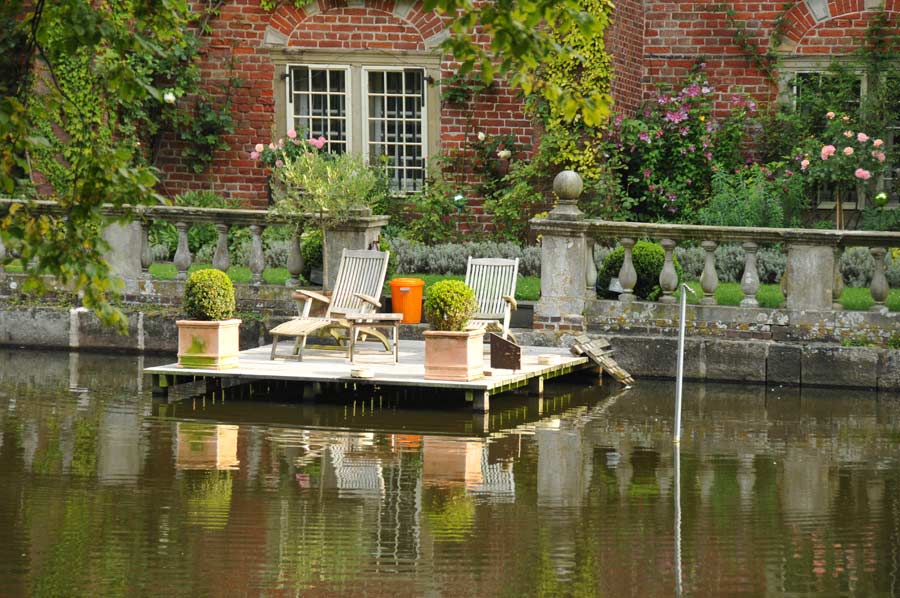
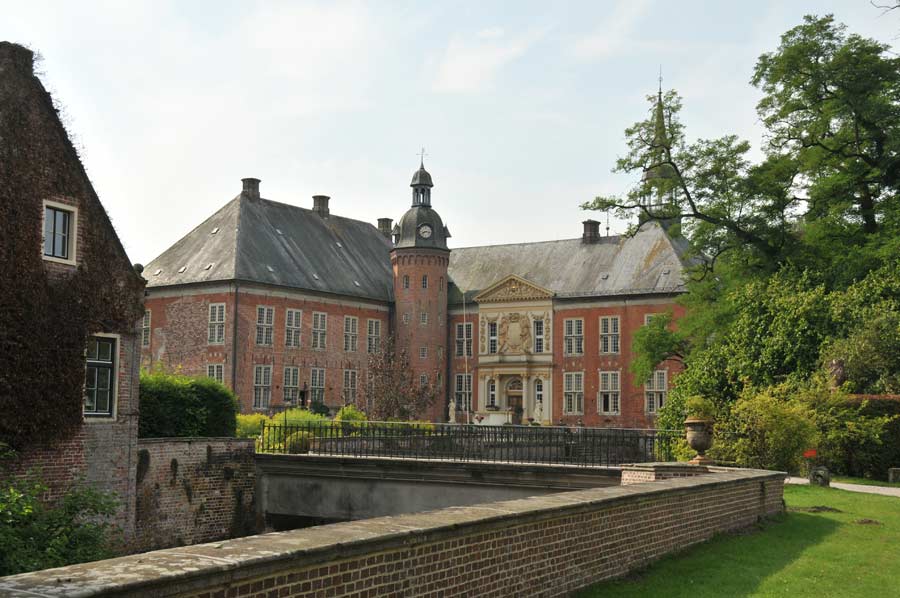
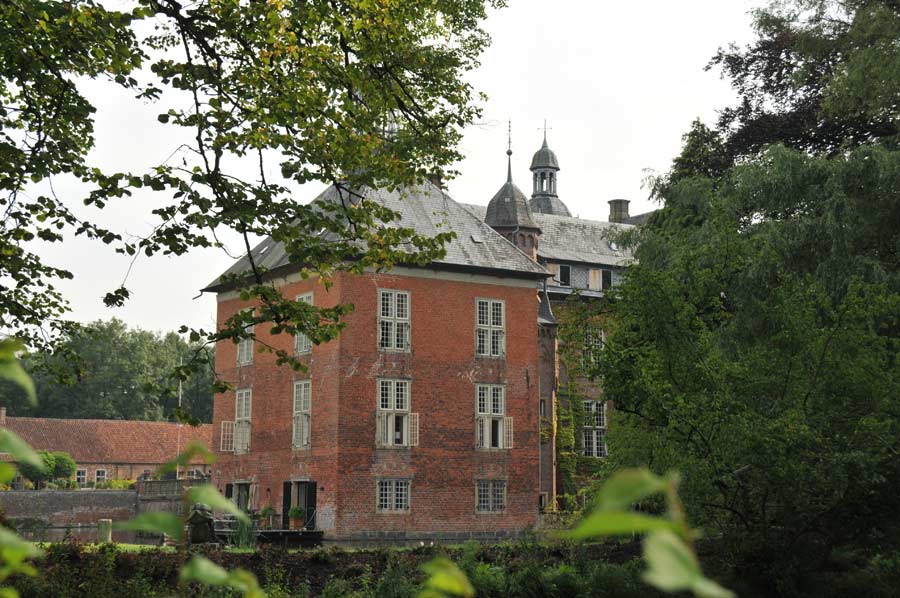
Gödens Castle itself is a clinker brick building in the Dutch Renaissance style, typical of this landscape, completely surrounded by a second, inner moat. There is only a small courtyard in front of the main entrance and a small garden at the rear of the building. Coats of arms and other ornaments can be seen above the entrance area to the right of the tower. Since the castle is still inhabited by a member of the von Wedel family, only a few rooms are open to the public, and even then, only during public events. Perhaps the most famous room is the so-called State Hall, with its depictions of Greek mythology. Today, the castle is managed by the Gödens Castle Cultural Heritage Foundation and is a listed building.
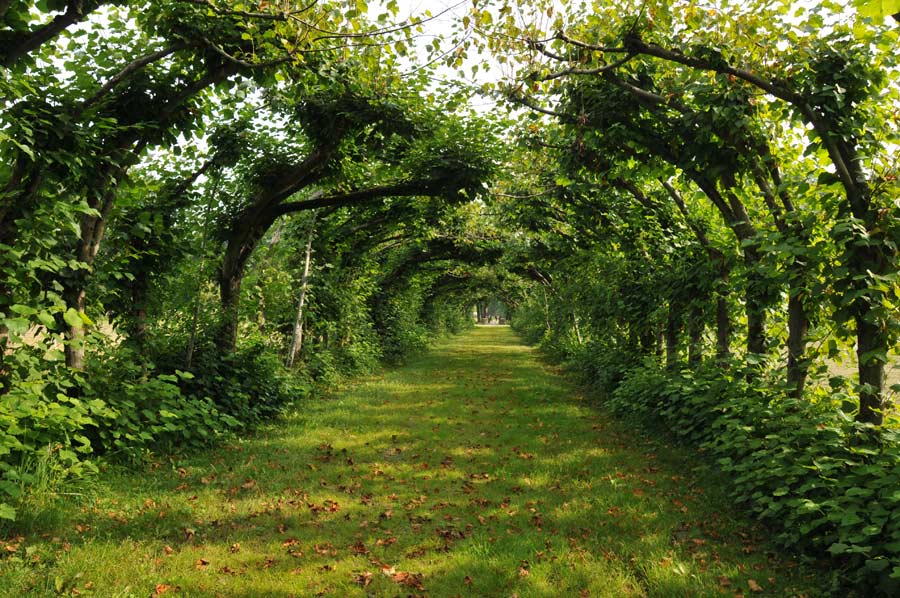
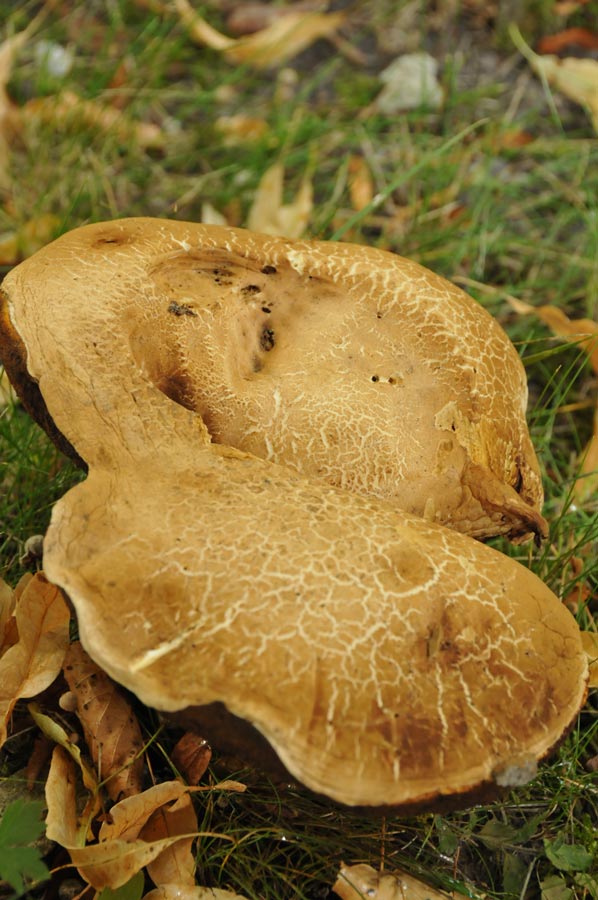 As already mentioned, the castle park is also freely accessible, with its impressive trees and a magnificent avenue of linden trees that form an almost closed tunnel, creating a changing play of light through the leaves of the green roof. Various sculptures complete the park, which is a long circular walkway.
The town of Neustadtgödens is directly related to Gödens Castle, not only in its name. When one of the largest storm surges since recorded natural disasters occurred in 1511, in which not only thousands of people lost their lives but also large areas of land were lost in the Jade Bay, construction began on embankments. The St. Anthony's Flood of 1511 caused the Jade Bay to expand to its greatest extent, and its water levels were recorded in many places, including at the harbour in Dangast.
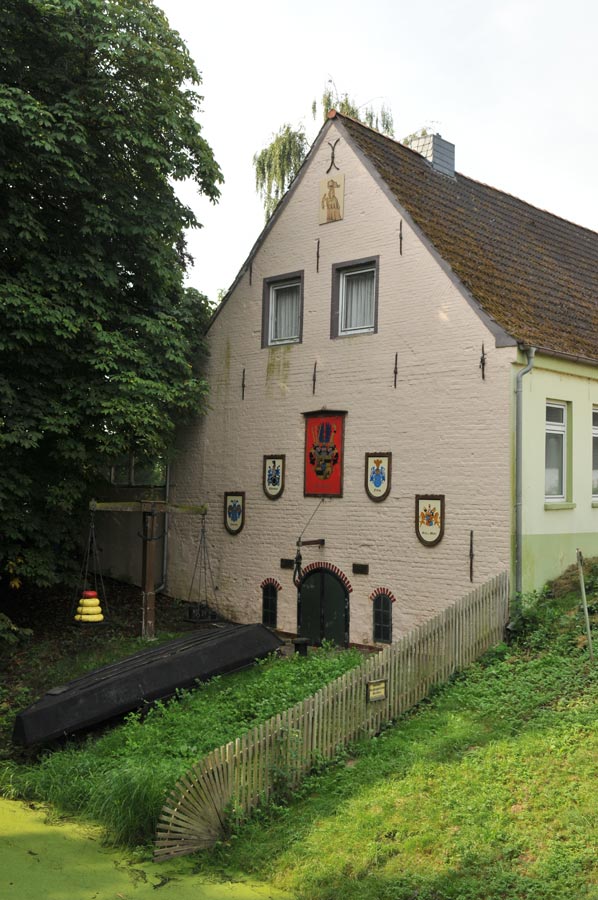 At that time, the noble counts and princely houses determined the prosperity and ruin of the land and its people. This was also the case in the Lordship of Gödens. Dike measures were therefore not only intended to protect the people, but also to maintain their own prosperity and the economy in the surrounding area. The then owners of the Lordship of Gödens, the aforementioned von Frydag family, also had a sluice built as part of the dike measures, which would develop into the nucleus of the later town of Neustadtgödens. The von Frydag family was known far beyond the country's borders for its religious tolerance and was thus able to contribute to the settlement of Mennonite religious refugees, some of whom were also specifically recruited as skilled workers. The community grew quickly, and the port contributed significantly to economic growth with good trade connections.
When the Ellenser Dam was built by Count Johann VII of Oldenburg in 1595, Neustadtgödens, as a settlement, was cut off from the sea. Initially, trade and shipping almost came to a standstill. Only in negotiations before the Imperial Chamber Court were some concessions for the future development of the town achieved. From a purely maritime trade, the town's image increasingly shifted toward weaving and the associated trade. This required vast bleaching meadows, which existed just outside the town gates, to bleach the woven fabrics. Around 1670, there were 66 weavers in Neustadtgödens, and around 1749, there was evidence of a full-time bleacher.
 Behind the houses on Kirchstrasse and Staustrasse stretched the commercial bleaching grounds for the weavers. The manorial lands provided sufficient sunny space to stretch the linen and let the sun bleach them. Ditches crisscrossed the areas to keep the linen moist. By the 17th century, Neustadtgödens had blossomed into a successful artisan town. Workshops were located in almost every house. Many were Mennonites, who specialized in the production of patterned napkins and tablecloths, as well as fine bed linens. In the 18th century, bleaching was entrusted to a full-time bleacher, who also guarded the linen and protected it from theft. Every citizen paid a tax, the so-called bleaching fee, to maintain the bleaching areas. Towards the end of the 18th century, the decline of the weaving industry was also evident in the slow deterioration of the bleaching area. Until the 20th century, the area was leased as pasture and hay land before being sold to the residents (in 1950) and converted into orchards.
Neustadtgödens was largely spared the effects of the Thirty Years' War thanks to the payment of compensation to Count Peter Ernst II of Mansfeld, which raged throughout the rest of East Frisia. With the marriage of Franz Ico von Frydag zu Gödens and the Catholic Margarethe Elisabeth von Westerholt, a period of unusual religious tolerance began. Franz Ico allowed his wife to practice her Catholic faith in Gödens Castle. Subsequently, residents of other denominations moved to the town, so that within just fifty years, five places of worship were built in the town, which at that time had a population of approximately 700 to 800. In addition to the Mennonites, people of Lutheran, Reformed, Catholic, and Jewish faiths lived here.
 The Count's House permitted the Lutherans to build their own church, making them the first religious community in Neustadtgödens. Until then, the Reformed Church in Dykhausen had been the only place of worship in the lordship of Gödens. Strong protests from the Reformed congregation accompanied the construction of the church in 1695. In 1708, Count Burchard Philipp von Frydag, as patron, issued his own church ordinance. The first interior furnishings included a baptismal font, lectern, and pulpit. Until 1968, the Count's Chair, representing the lordship of Gödens, was located at the very front of the nave. The coat of arms of the Lords of Wedel in the front row is a final testament. In 1714, a tower was added to the nave. It was not originally planned and therefore extends far into the street. Originally, only the pastor used the entrance portal bearing the count's coat of arms, while the congregation entered through the south door, which was walled up during the major reconstruction of 1906. Musical accompaniment by a cantor replaced an organ in 1741. In the same year, a Lutheran school was built next to the church, which became the community school in 1876. The adjacent old cemetery remained in use until the cemetery was established on the edge of town in 1906.
 The first Jews had settled in Neustadtgödens around 1640, and the first mention of a synagogue in the village dates back to 1752. The synagogue building, which still stands today, was built in 1852. The east side, with the Torah shrine, was designed as a prestigious display area, featuring a Hebrew inscription in the gable window and the Star of David on the gable. Men entered the synagogue through the rear, while women entered the women's gallery through a door on the south side. In 1812, the Jewish community purchased a residential building next to the synagogue. The old building was demolished, and a separate school was established in the new building. In 1903, the school moved to a building opposite. Classes were held there until 1922. In 1936, the last service was held in the synagogue. A private citizen acquired the place of worship and used it to store paints and varnishes. It is likely thanks to this circumstance that the synagogue was spared the flames during Kristallnacht. Many of the local Jews did not survive the Nazi regime. After the Second World War, the synagogue was converted into a residential building and later into a fire station. From 1986 to 1988, the synagogue was rebuilt and restored, initially serving as a gallery and now as a vacation home.
The historic weighing house is located directly on the sluice. It was used to weigh all goods traded at the sluice harbour in order to determine the taxes to be paid to the ruling von Gödens family. These taxes were an important source of income for the von Gödens family. The family coat of arms of Franz Ico von Frydag is now located on the weighing house.
 The Landrichterhaus (District Judge's House) stands in the immediate vicinity of the historic village. From the beginning of the 17th century until 1743, the Lordship of Gödens maintained its own district court here. Since 1986, the historic building has housed a museum featuring an exhibition on the history of Neustadtgödens.
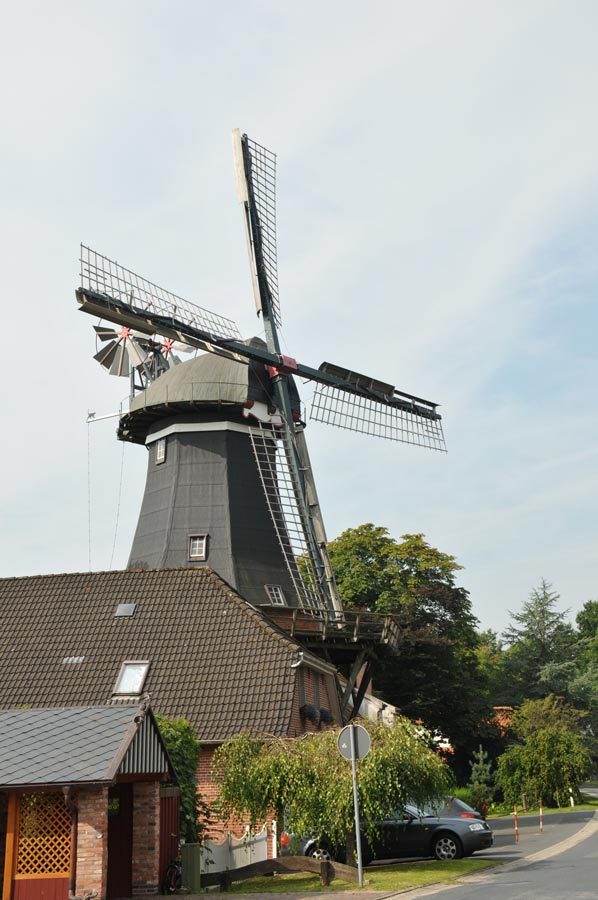
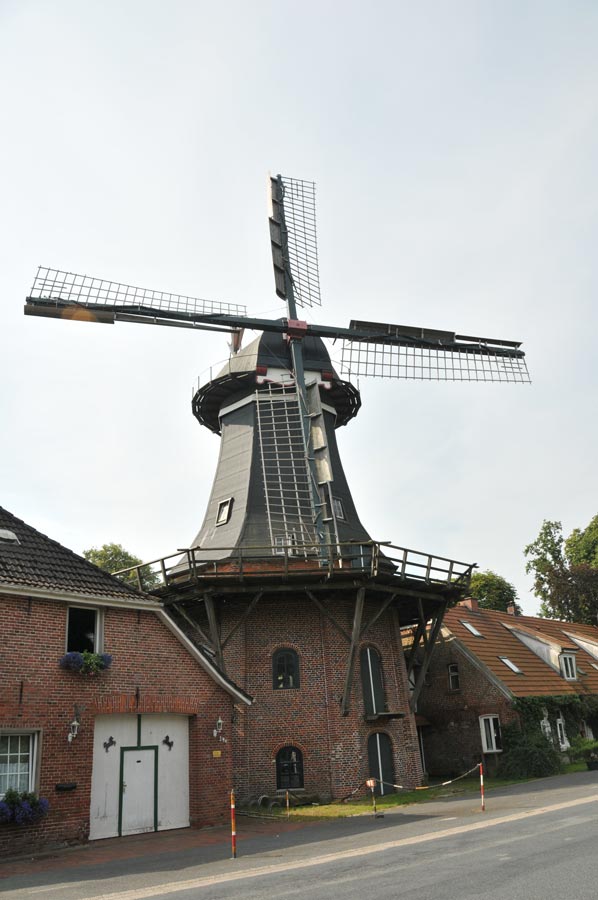
Two Dutch windmills are located on the outskirts of the village. The Oberahmer Peldemühle (Pelde Mill) was built as a two-story gallery windmill in 1764 on the territory of Jeverland. With its construction, the Count of Gödens responded to a Prussian Milling Edict that curtailed the Lordship's rights to their mills. The Wedelfelder Wasserschöpfmühle (Water Pump Mill) was built in 1844 as one of the last of these mills in East Frisia and served to drain the Black Bracks, which lies partially below sea level.
Please also read:
Early Romantic Castle Park in Lütetsburg
Dangast - Culture and Rhubarb Cake
♁53° 29′ 7.1″ N, 7° 57′ 53.2″ E
https://www.alaturka.info/en/germany/lower-saxony/7016-goedens-moated-castle?layout=default%2Famp%2Famp%2Famp#sigProId717c6acf79