


Steinburg – Castle in Need of Renovation in Beautiful Landscape
- Written by Portal Editor
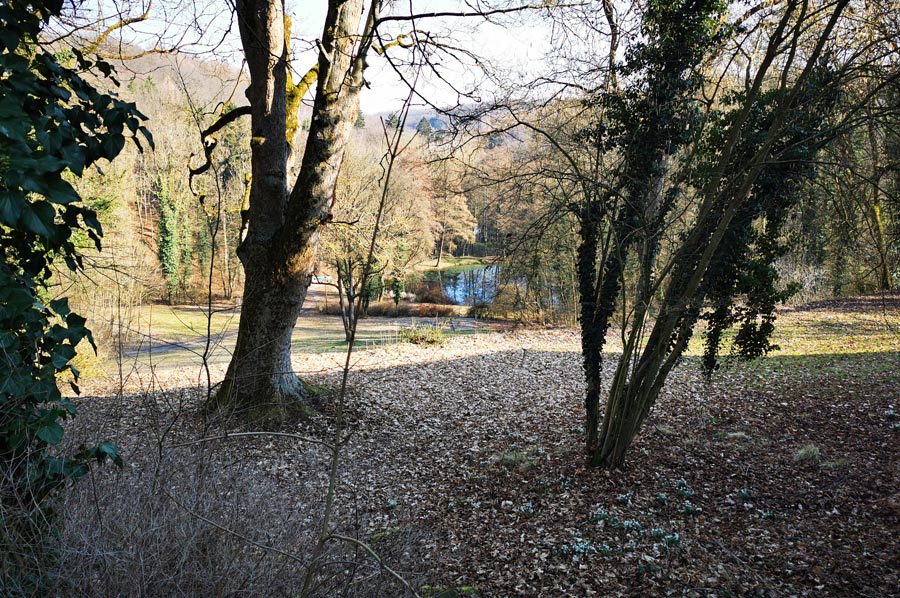
Steinburg – The first rays of sunshine in March had inspired us to get our bikes ready again, so we decided to take a short exploratory ride in the surrounding area.
We had heard several times about the church ruins in the center of Steinburg, and also that the castle complex was due for renovation. Upon our arrival, we were completely surprised to find a beautiful park below the castle, which even included a small reservoir with a rest area. After circling the lake and taking a short break, we used the signs to determine the route ahead, which would take us relatively steeply uphill through the forest to Bad Bibra. Our first ride of about 26 kilometers on our beloved bikes was complete. But now for the details in Steinburg.
Steinburg - Church Ruins and Castle Complex on a Rocky Outcrop
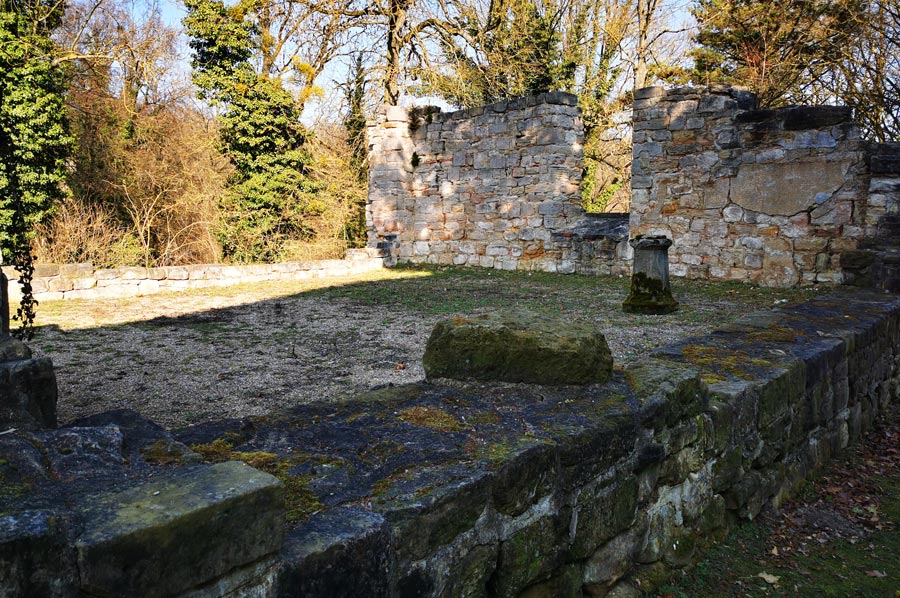 The name Steinburg, the general location of the town, and the existence of the castle reveal that the entire settlement grew out of an older fortification. Little is known about its founding year or its builder. The castle was first mentioned in 1306 in connection with a Heinrich von Steinburg, a vassal of the Counts of Rabenswalde, who had commissioned its construction around 1300. In 1349/50, it was owned by Johann von Steinburg, a vassal of Margrave Frederick the Strict. In 1360, a knight named Luthulf Marschall appears at Steinburg Castle. In 1426, the noblemen Hans and Brun von Querfurt were enfeoffed with Steinburg. They were followed by the Koller family (1438 to 1570), the von Miltitz family, and the von Selmnitz family (1597 to 1686). In 1597, the castle was destroyed by fire. Further damage and plundering occurred during the Thirty Years' War, and by 1644 the castle was considered deserted.
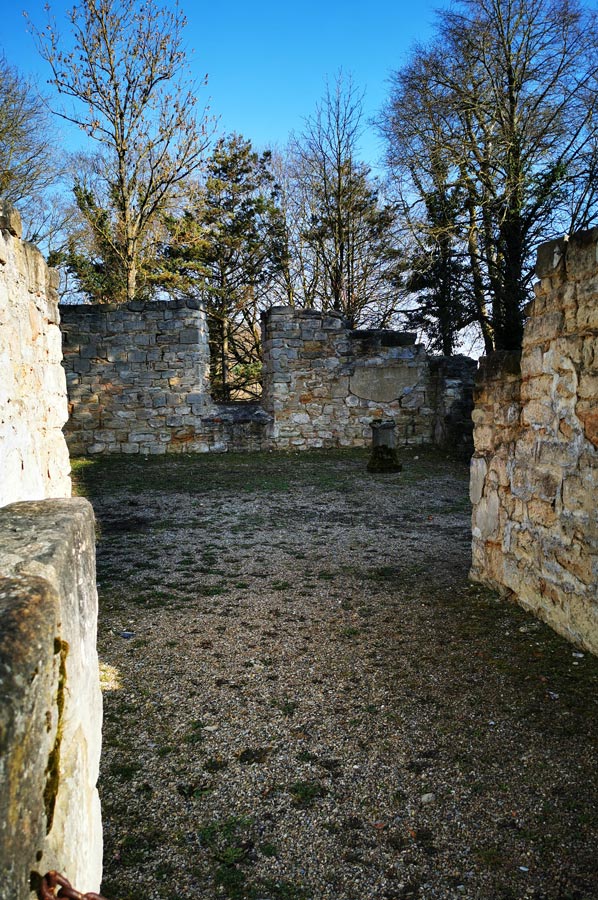 In 1686, Ernst Friedemann von Selmnitz sold the estate to his son-in-law, Gerlach Heino von Münchhausen, who restored the castle. In 1710, his son, Philipp Adolph von Münchhausen, inherited the property. The von Münchhausen family also laid out the park and remained in Steinburg until their expropriation during the land reform of 1945. From 1764, the Steinburg branch of the family also owned the Bettensen estate near Hanover. After the land reform, the castle served as a children's home in 1947, then as a holiday home for Caritas, and later as a training center for the Society for Sport and Technology. From 1971, the Martin Luther University of Halle used it as a children's holiday camp. Since 1997, it has been privately owned again but stood empty. At the time of our visit, we found the entire facade covered in scaffolding, suggesting that restoration work was underway.
Background to the Castle, although little is known
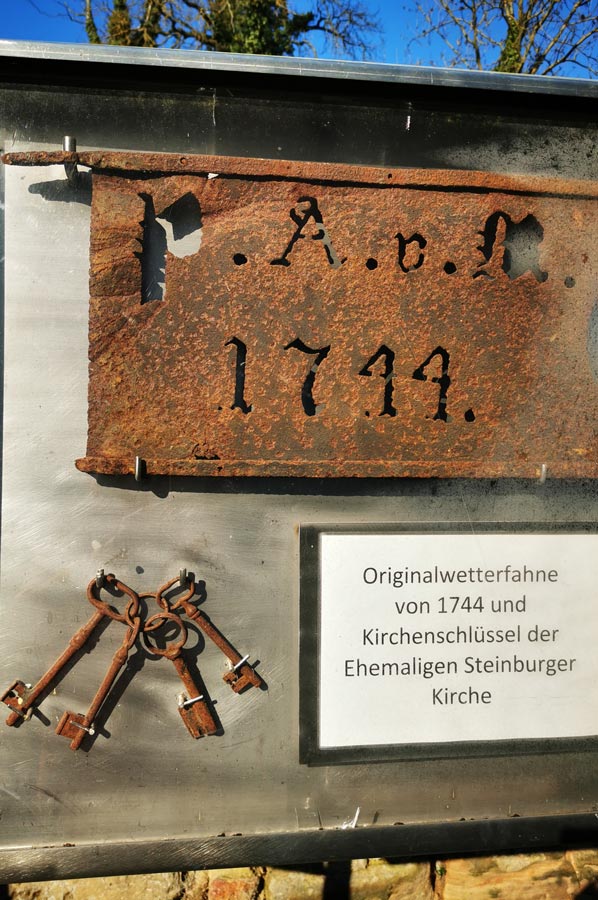 Once, the outer bailey and castle extended along an eastward-projecting ridge. No significant structural remains of this original structure survive. The two parts were separated by a moat. Today, the area of the outer bailey is largely occupied by houses belonging to the village. The village itself was protected by a rampart, the remains of which are still visible to the north.
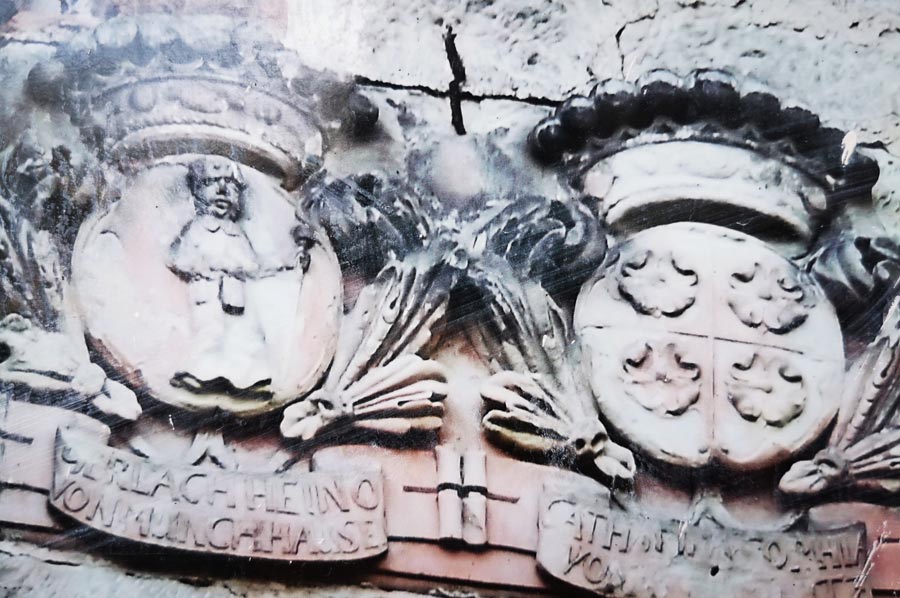
It is assumed that the original structure may have been one of the numerous border castles of the Carolingians, which secured the borders of the imperial territory. The Lords of Münchhausen had a Baroque castle complex built on a horseshoe-shaped ground plan. Later alterations and modifications changed its original appearance. The rather austere-looking castle now shows clear signs of neglect. The coats of arms of Gerlach Heino von Münchhausen and his wife are visible on the facade facing the park. Inside, nothing of the original Baroque furnishings remains.
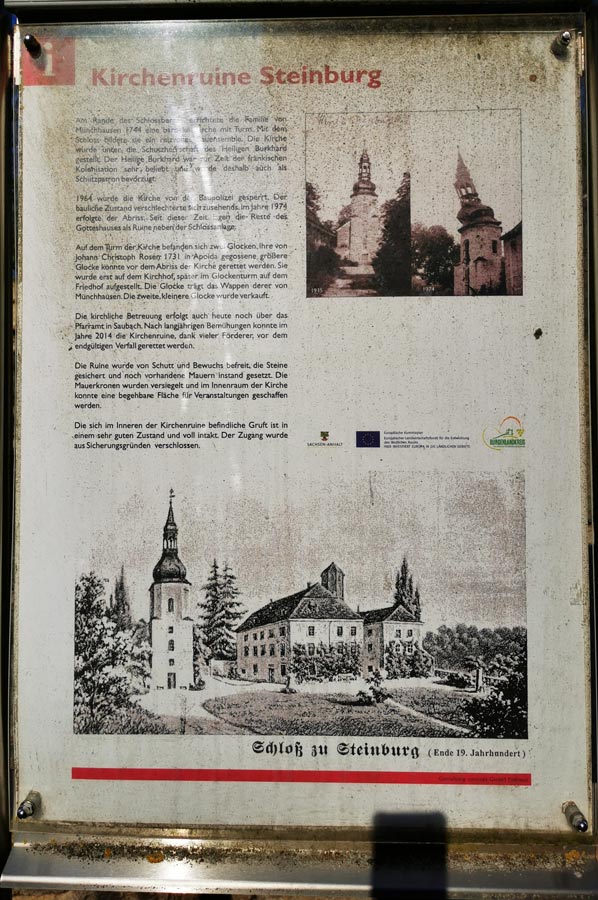 Only the layout of the castle park is recognizable from the original plan. First mentioned in 1728 as a "pleasure rose and rampart garden," this garden remains charming despite a lack of professional maintenance. It encircles the entire settlement, emphasizing the village's idyllic character and unfolding its grandest backdrop at the castle. It acquired its present form in 1846 according to plans and under the direction of the Weimar landscape architect Eduard Petzold (1814–1891), as he recounted in his memoirs. Thus, the Baroque layout of the grounds disappeared in favor of an expansive park. Petzold viewed the park and the surrounding landscape as a unified whole and incorporated the village, the church, and the old Ottenmühle (formerly the castle mill) on the Steinbach stream into his design. The castle, at the center of the ensemble, still offers a captivating panoramic view. The rediscovery of a zest for life and nature during that era is reflected in the interplay between landscape and architecture.
 Today's Steinburg stretches from a small west-east oriented spur of land along two modern access roads and then along the spur itself. Visitors will find a tranquil village that exudes a soothing peace and serenity.
For millennia, humankind has used, shaped, and influenced nature. Something new has emerged – our cultural landscape. It vividly illustrates the region's development. Alongside unique flora and fauna, a remarkably high density of monuments and landscape features has been preserved in a largely authentic form within a small area. Much has been researched and is known, yet the mysterious, legendary, and little-explored relics created by our ancestors still remain. Preserving them and bringing them to the public's attention is our mission.
Please read as well: