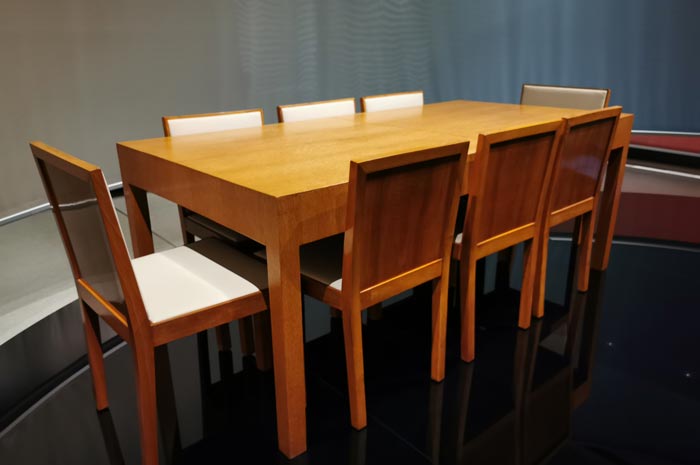
Furniture Design at the Bauhaus – Exhibition in Weimar

The "Staatliches Bauhaus" commonly referred to simply as the Bauhaus was an art school founded in Weimar in 1919 by Walter Gropius. In terms of its nature and concept, this educational institution was something entirely new at the time: a synthesis of art and craftsmanship.
The original intentions of Henry van de Velde and Walter Gropius were to emancipate art from the effects of industrialization and to revitalize artistic craftsmanship by reconnecting it with traditional trades.
In doing so, they offered an alternative to the aesthetic of Historicism, a period characterized by the mass-produced, industrial replication of ornaments originally conceived through individual craftsmanship.
While laypeople often speak of a "Bauhaus style," both architectural and art-historical scholarship caution against viewing developments at the Bauhaus in isolation or using "Bauhaus" as a label for a specific style (such as an architectural or furniture style).
The "Staatliches Bauhaus" was envisioned by its founder, Walter Gropius, as a collaborative community in which the distinction between artist and craftsperson would be dissolved. Through their work, members of the Bauhaus sought to eliminate social divisions and foster international understanding.
Another revolutionary, foundational principle of the Bauhaus was the equal status afforded to men and women at the school. In the winter semester of 1919/20, the number of female students was nearly equal to that of male students; a year later, there were 62 women and 81 men.
In the program issued at the opening of the Bauhaus in 1919, Walter Gropius declared: "Any person of good repute, regardless of age or gender, whose talent and prior training are deemed sufficient by the Council of Masters, shall be accepted as an apprentice." The Bauhaus was thus one of the first institutions to grant women free access to a public art school.
“The ultimate aim of all creative activity is a building! Architects, sculptors, painters we all must return to craftsmanship!” Walter Gropius: Bauhaus Manifesto

Studies at the Bauhaus were divided into three stages. The preliminary course (*Vorlehre*) consisted of six months of instruction in form and exercises with materials. This was followed by admission to the workshop training (*Werklehre*), where students could choose between various specialized workshops.
The third stage was architectural training (*Baulehre*), which involved working on construction projects for a variable duration. Upon completion, students received a master craftsman’s diploma from the Chamber of Crafts and, in cases of exceptional talent, one from the Bauhaus itself.
Some Bauhaus students remained at the institution after their training, continuing on as master craftsmen. Works and documents from the Bauhaus, along with relevant literature, are collected and made accessible to the public at the Bauhaus-Archiv (Berlin) and the Bauhaus-Museum (Weimar).
Please read as well:
Antoni Gaudí – Spanish Architect and Exponent of Modernism
Falconry – A Presentation of Falconry at the Apple Festival at Schloss Kaartz