Antoni Gaudí – Spanish Architect and Exponent of Modernism
For many years, we have explored ancient architecture, while never losing sight of the modern era a perspective that also aligns with one of our recurring core themes: migration.
For instance, we have previously covered the Austrian architect Clemens Holzmeister, who emigrated to Turkey even before the National Socialists came to power. To this day, many of his structures such as Atatürk’s urban villa, the Ministry of Defense, the Central Bank, the Supreme Court, and the Parliament building remain as a testament to his work.
Also worth mentioning is the renowned architect Friedensreich Hundertwasser, who became known as an outspoken opponent of the "straight line" and any form of standardization or typification. This stance remains highly significant in his architectural and design work, which is characterized by an imaginative vitality and a strong sense of individuality.
Antoni Gaudí i Cornet – an architect associated with the Catalan *Modernisme* movement.
 The movement known in German as *Modernismus* (Modernism) was a cultural, artistic, literary, architectural, and theological trend that spanned from the late 19th century to the mid-20th century. It was embraced by numerous architects though its influence extended well beyond the realm of architecture alone.
A central goal of this shift was a deliberate break with tradition and inherited historical forms, favouring innovation, experimentation, and new modes of expression.
A functional design approach, often stripped down to the essentials (as seen, for example, in the architecture of the Bauhaus architecture, featuring architects Walter Gropius and Mies van der Rohe or *Modernisme Català*), which consciously turned away from historical ornamentation.
 Gaudí’s childhood was marked by a severe rheumatic illness. Because this condition prevented him from playing with other children leading him instead to observe nature and his surroundings this may perhaps explain his later, nature-inspired architectural style.
During his time at the Piarist Fathers’ school in Reus and later at the School of Architecture in Barcelona, where he studied from 1873 to 1878, he was not known for particularly high academic marks; however, he distinguished himself from his peers as an exceptional and creative draftsman. When Gaudí received his degree from the School of Architecture on March 15, 1878, the institute’s director, Elies Rogent, remarked:
“Qui sap si hem donat el diploma a un boig o a un geni: el temps ens ho dirà.”
“Who knows whether we have awarded this diploma to a madman or a genius only time will tell.”
 From the very beginning of his studies, he worked for various architectural firms, including those of Francisco de Paula del Villar y Lozano, Josep Fontserè, and Joan Martorell. His first major project involved the planning of a factory and a workers' housing estate for the *Sociedad Cooperativa La Obrera Mataronense* (1878–1882). However, the construction failed at an early stage. In 1878, Gaudí met Eusebi Güell, with whose financial support he was later able to realize significant works such as the Güell Pavilions, the Palau Güell, Park Güell, the Bodegas Güell, and the crypt of the Colònia Güell.
As a Spanish entrepreneur, patron of the arts, and politician, Eusebi Güell benefited from the Industrial Revolution in Catalonia during the late 19th century. Güell had first taken note of Gaudí in connection with a smaller-scale project for the 1878 Paris World's Fair. The two men shared a lifelong friendship and a professional relationship, as well as a deep sense of religiosity. Güell introduced Gaudí to the city’s high society and helped secure several commissions for him, even though the majority of people at the time remained sceptical of Gaudí’s work.
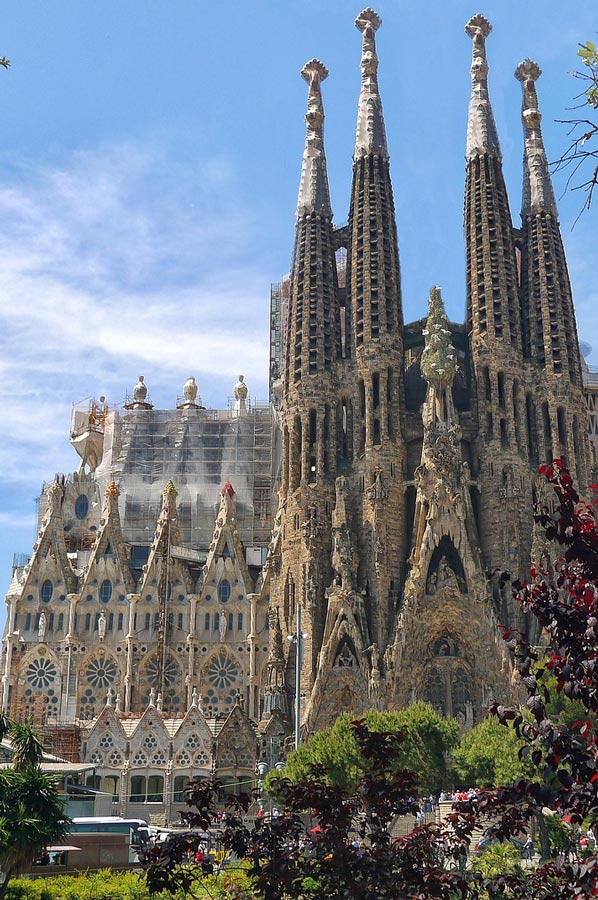
 In March 1883, he took charge of the construction of the Sagrada Família a project begun in 1882 to which he dedicated himself entirely from 1914 to 1926. For the design of the load-bearing structures, Gaudí frequently employed the principle of hanging models. This method allowed him to realize complex forms with minimal material usage and without the need for elaborate calculations, as the vaults are subject only to compressive forces. This type of construction is also known as a Catalan vault. The arches Gaudí used are based on the principle of an inverted catenary curve (catenoid); for the towers, these are executed as rotational catenoids, while in other instances such as saddle-shaped vaults they resemble a hyperbolic paraboloid.
The Sagrada Família church in Barcelona became the defining work of Gaudí’s life; he worked on it for nearly his entire career as an architect. Although still unfinished, the church is today the most iconic landmark in Barcelona. On November 7, 2010, it was consecrated by Pope Benedict XVI and elevated to the status of a minor basilica.
 In 1884, Gaudí received his first commission to design several pavilions, a perimeter wall, and an entrance gate for the Finca Güell. Just two years later, construction began on the Palau Güell, the Güell family’s new urban residence in Barcelona.
The Bodegas Güell complex was built between 1895 and 1901 under the supervision of Francesc Berenguer, one of Gaudí’s assistants, and stands as an avant-garde example of winery architecture.
In 1898, Güell commissioned Gaudí to build a church for his workers' settlement, the Colònia Güell, located in Santa Coloma de Cervelló near Barcelona. Following a long planning phase and persistent technical problems, the church remained unfinished. Only the crypt and the portico were ever built.
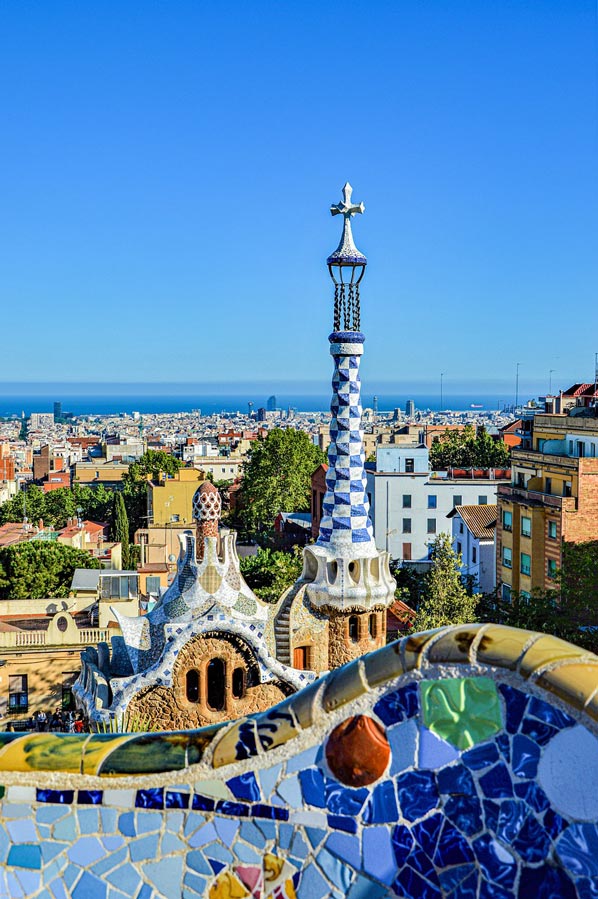
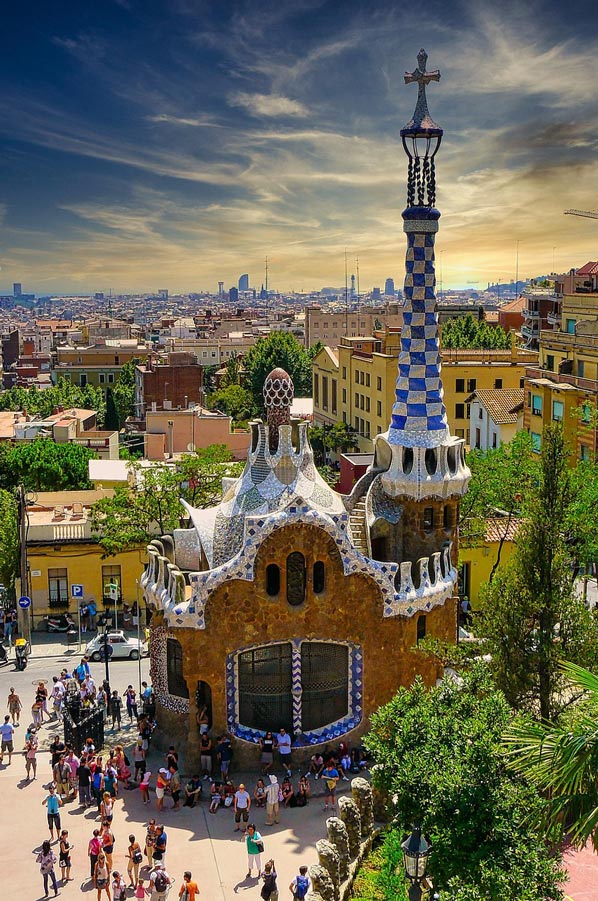
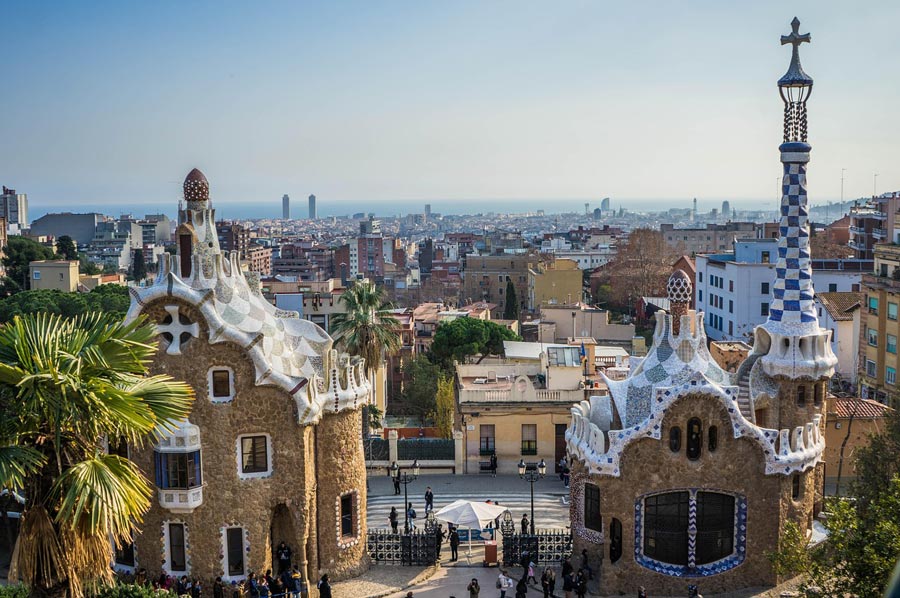
In 1900, Gaudí began construction on Park Güell. Güell had originally envisioned a "garden city" designed for an upscale clientele; however, the project was never fully realized as there was insufficient interest in the 60 villas that had been planned. Today, it is the city’s most famous park and a major tourist attraction.
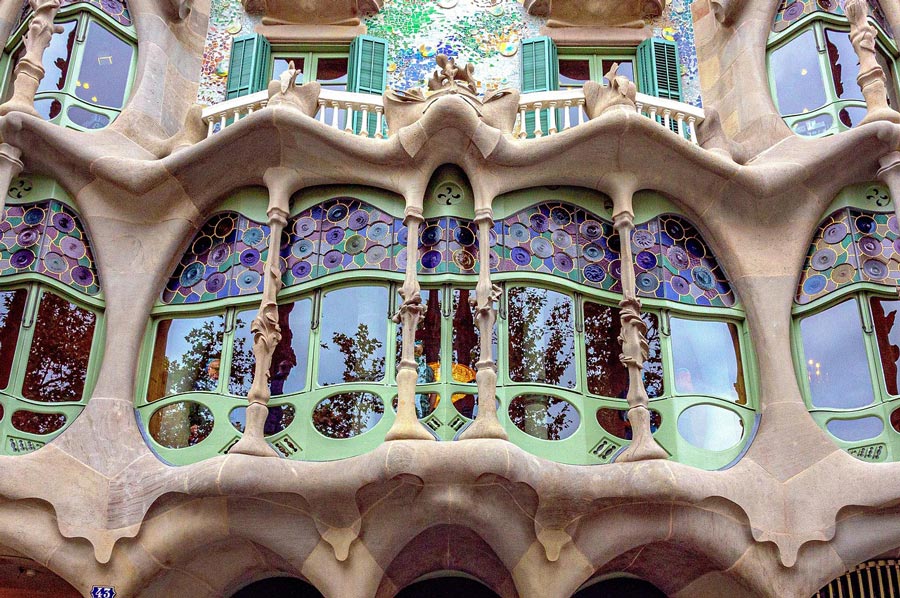
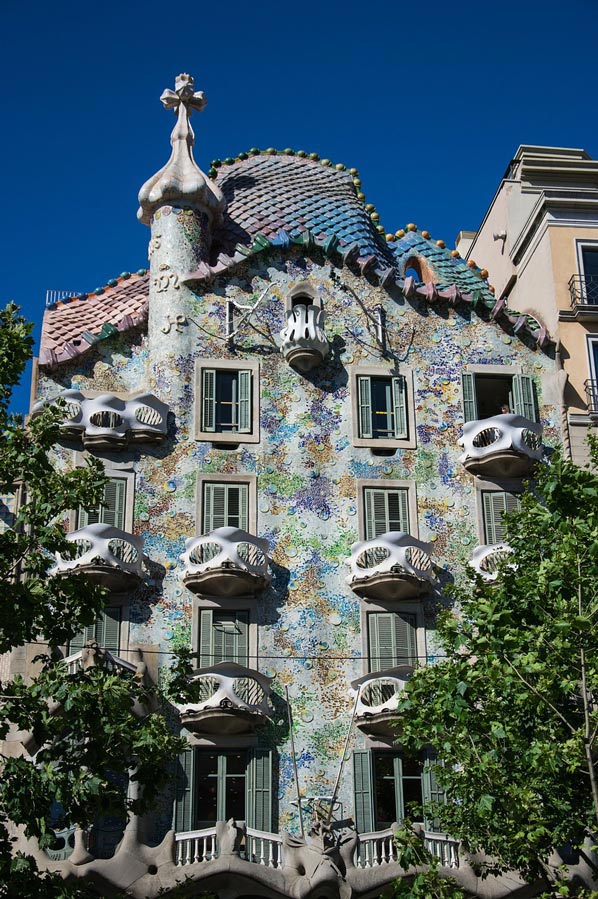
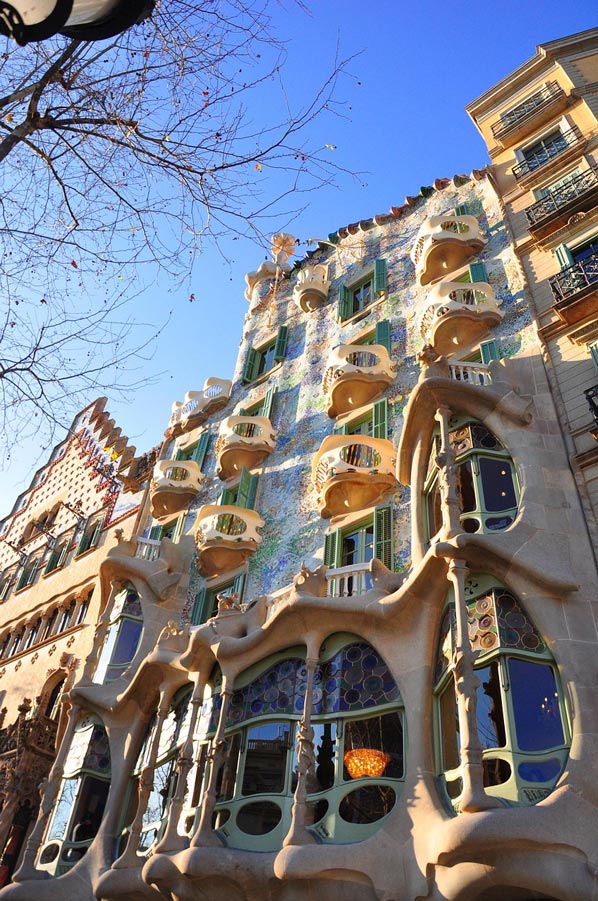
Between 1904 and 1906, Gaudí redesigned the Casa Batlló. In 1906, his father, Francesc Gaudí i Serra, passed away at the age of 93. Gaudí’s final major works included the aforementioned Park Güell, the crypt at Colònia Güell, and the construction of the Casa Milà also known as "La Pedrera."
 On June 7, 1926, while walking from his daily morning visit to the Oratory of Saint Philip Neri toward the Sagrada Família construction site, Gaudí was struck by a tram and left unconscious. Because he was not carrying any identification and his dishevelled appearance led people to mistake him for a beggar, he did not receive appropriate emergency medical care. It was only after several hours that a police officer arranged for him to be taken by taxi to the Hospital de la Santa Creu, a hospital for the poor. Three days later, his friend and closest collaborator, Domènec Sugrañes, along with the chaplain of the Sagrada Família, Msgr. Gil Parés, discovered him there and had him moved to a private room. Gaudí passed away on June 10, 1926, three days after the accident.
The entire city was plunged into deep mourning. Thousands came to pay their final respects to Gaudí. The government ordered his burial in the crypt of the then-unfinished church of La Sagrada Família, a decision for which Pope Pius XI granted his consent. Antoni Gaudí found his final resting place in the very spot where he had spent the better part of his life working: the Sagrada Família.
Please read as well:
Falconry – A Presentation of Falconry at the Apple Festival at Schloss Kaartz
Adventurous camping trips or a slower pace of life just around the corner