A Hike from the Goseck Circular Ditch Enclosure to the Manor Estate
We have visited the solar observatory in Goseck several times, and on this occasion, we had hoped to join a guided tour of the circular ditch enclosure something that greatly interests us.
Upon arrival, however much like several other visitors we discovered that advance registration by phone was required. Since we were already there, we decided to hike to the manor estate (Rittergut) of the Goseck lordship, situated high above the Saale River. From the solar observatory, the path leads toward a forest; after crossing it, you reach a narrow trail that runs along the Saale Valley a route that is actually quite easy to find, thanks to the signage.
The Construction of Circular Ditch Enclosures – A European Phenomenon
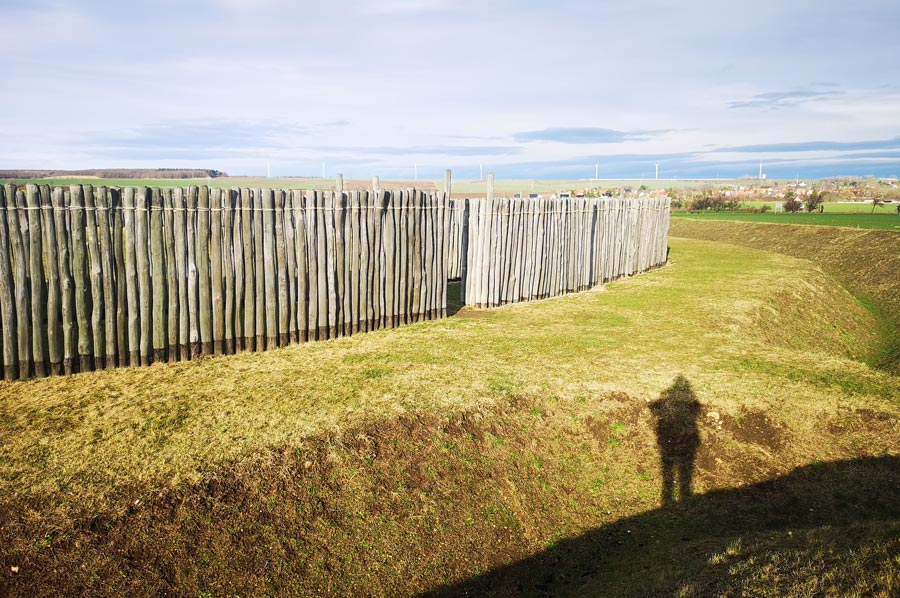 During the first half of the 5th millennium BC, people across a region stretching from Hungary to Bavaria, and from Lower Austria to Brandenburg, constructed large circular ditches, accompanied on the inside by imposing palisades.
While these sites differ in their specific details, they share a number of common features. These include a roughly circular ditch with a V-shaped cross-section, internal rings of palisades, an empty, uninhabited central area, and two to four gateway-like breaks in the ditches and palisades.
Using only simple tools, these people created circular enclosures measuring between 60 and 150 meters in diameter, with ditches up to 10 meters wide and five meters deep. Furthermore, they installed thousands of wooden posts.
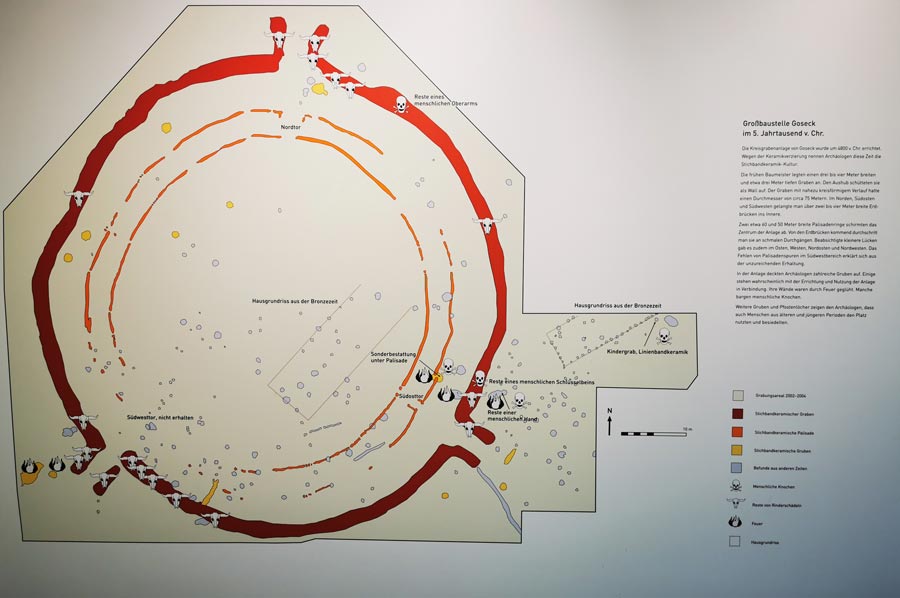 This immense undertaking was a collective effort, involving people from several different settlements.
As central hubs, these circular ditch enclosures served to separate a sacred space from the broader settlement area. They functioned as sites for rituals and gatherings, and may also have served as venues for initiation rites, funerary ceremonies, or the administration of justice.
Beyond the rapid spread of the "circular ditch" concept, another previously unclear aspect was why these sites were abandoned after, at most, five or six generations.
Goseck – Europe’s Oldest Solar Observatory
 The first traces of human settlement in the Saale-Unstrut region date back to the Neolithic period, around 5000 BC. Evidence of this is provided by the circular ditch enclosure at Goseck discovered via aerial photography in the 1990s and excavated since 2003 which stands as Europe’s oldest solar observatory.
It is a circular enclosure with a diameter of 75 meters, dating from the Middle Neolithic.
The site marks the beginning of a millennia-old tradition of early celestial observation a tradition also reflected on the Nebra Sky Disc, which was discovered just 25 km away in 1999.
Using sighting mechanisms, people were able to precisely determine dates such as the summer and winter solstices.
The reconstructed observatory was inaugurated on the winter solstice, December 21, 2005, with a spectacle of light and fire.
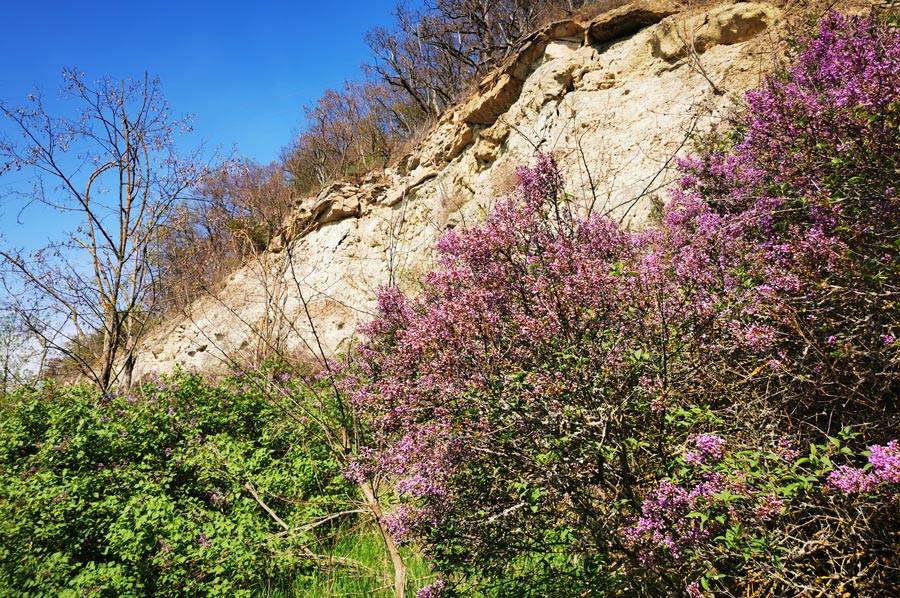 Leaving the solar observatory, we head toward the forest, follow a concrete track to the right, and then turn left through the woods toward the Saale Valley. Thanks to clear signage, the path is easy to follow.
From this point, one could also choose to hike to other destinations, such as the towns of Naumburg or Freyburg.
A short while later, the Saale Valley opens up; we follow a narrow path to the left, heading toward the Rittergut (manor estate).
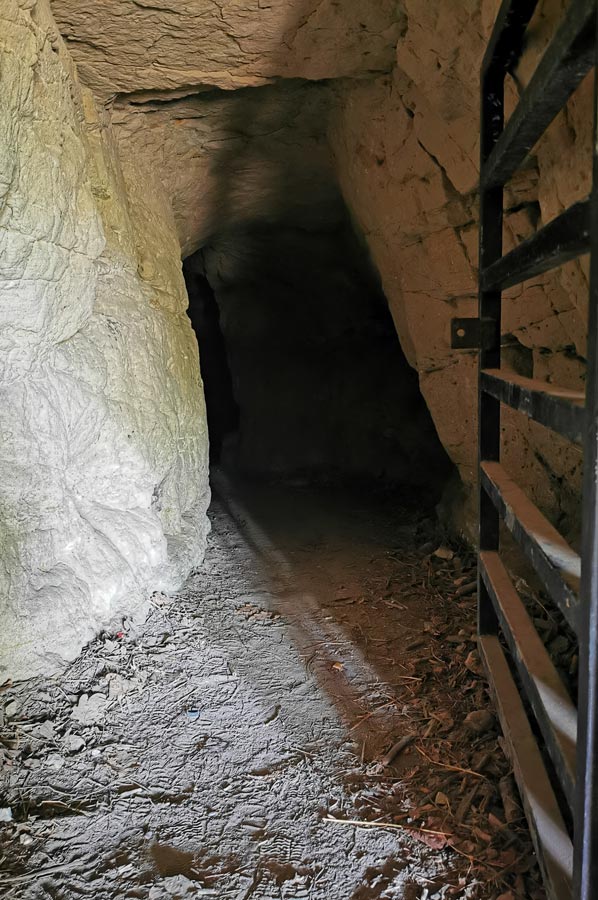
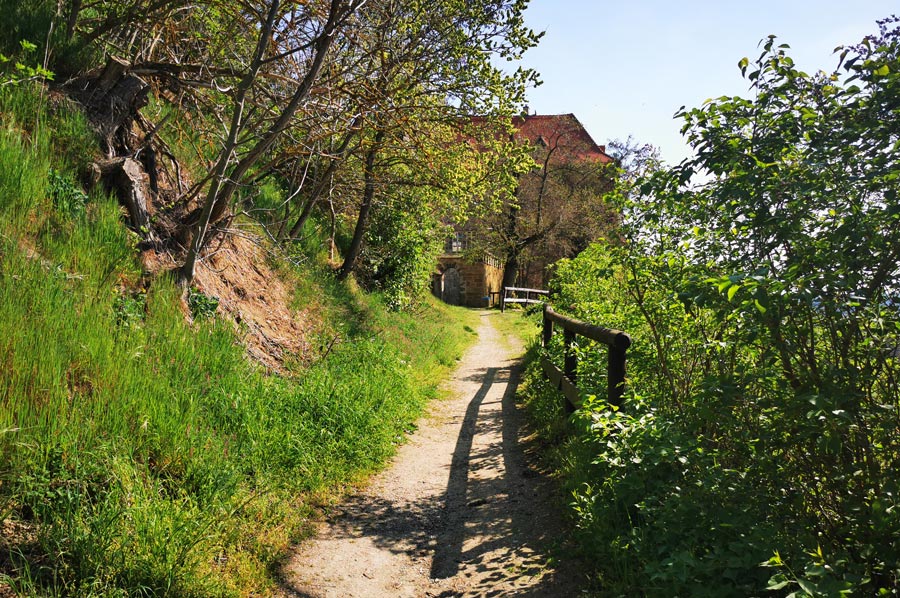 Almost hidden among a profusion of blooming lilac bushes, we come across a tunnel-like opening in the riverside rock a discovery that immediately piques our interest.
Lacking proper lighting, we follow the corridor until our mobile phone flashlights are no longer sufficient to see our way.
We will be better equipped for our next visit for now, it’s back to the hiking trail.
From Former Monastery to Goseck Manor
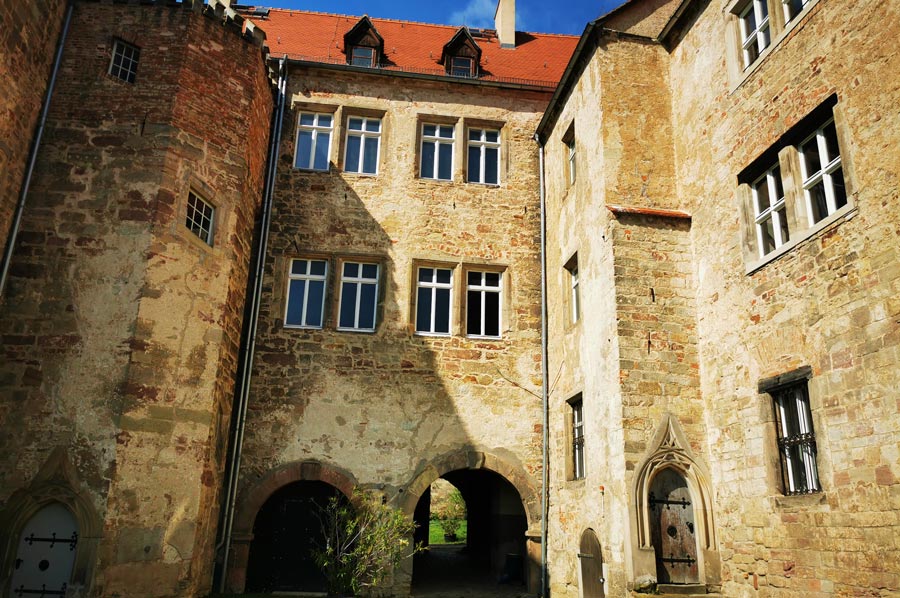
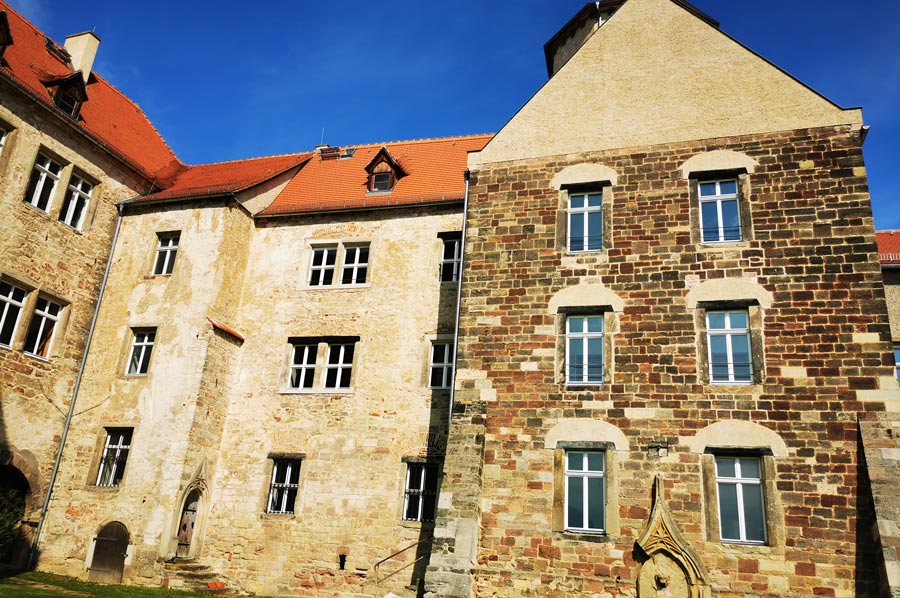
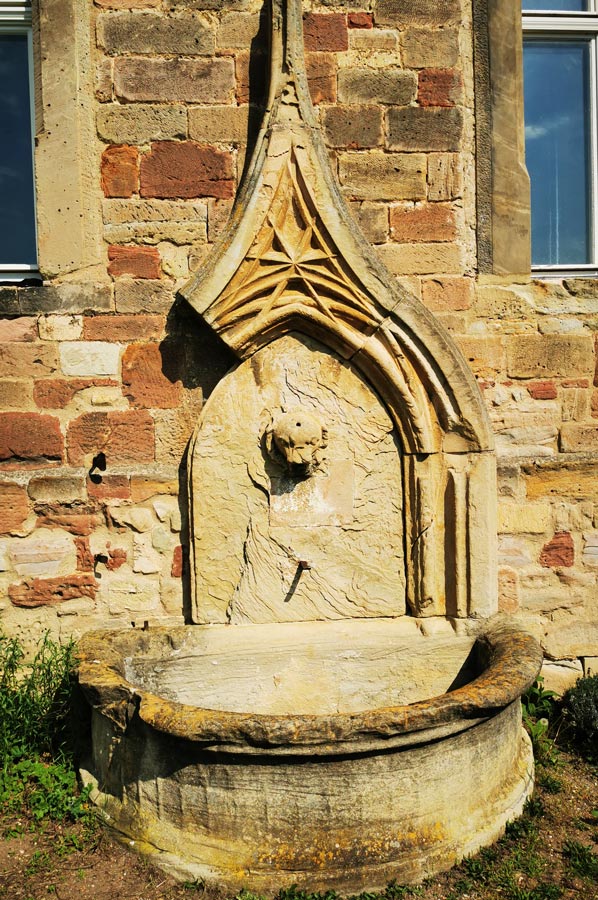 Following the Reformation in 1540, the former monastery at Goseck was secularized and converted into a manor the seat of the Goseck estate.
From that point on, the main building became known as Goseck Castle.
The village of Goseck itself developed in connection with the founding of Goseck Castle.
Until 1815, it belonged to the *Amt* (administrative district) of Freyburg, part of the Thuringian Circle within the Electorate of Saxony.
The Goseck estate encompassed the villages of Goseck, Dobichau, Kleingräfendorf, and Pettstädt, as well as parts of the villages of Markröhlitz and Eulau; the village of Lobitzsch fell under its parish jurisdiction.
 As a result of the Congress of Vienna, the village passed to Prussia in 1815; in 1816, it was incorporated into the district of Querfurt, within the Merseburg administrative region of the Province of Saxony.
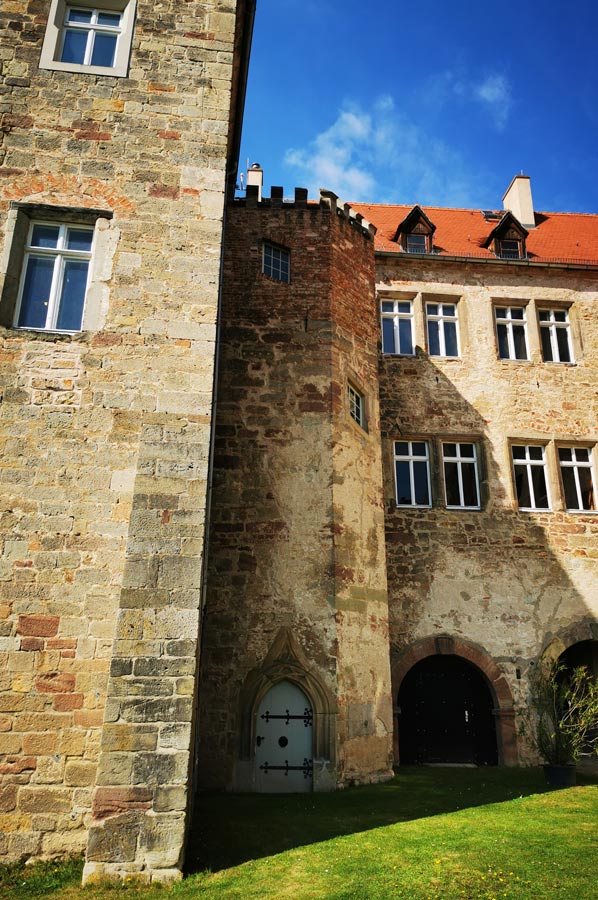
Today, the site houses a small museum dedicated to the circular ditch enclosure an ancient solar observatory and there is also a popular, well-frequented restaurant located in the castle courtyard.
For the first time, we find the church open to visitors, allowing us to descend all the way into the sacristy.
 It is a highly worthwhile detour for anyone interested in church history leading up to the Reformation. We can certainly recommend a visit.
The route back to the solar observatory and thus to where our vehicle is parked takes us through the village of Goseck this time.
Once again, an interesting hike in the region.
Please read as well: