


Monasteries – Italy’s Most Beautiful (Former) Monasteries
- Written by Portal Editor
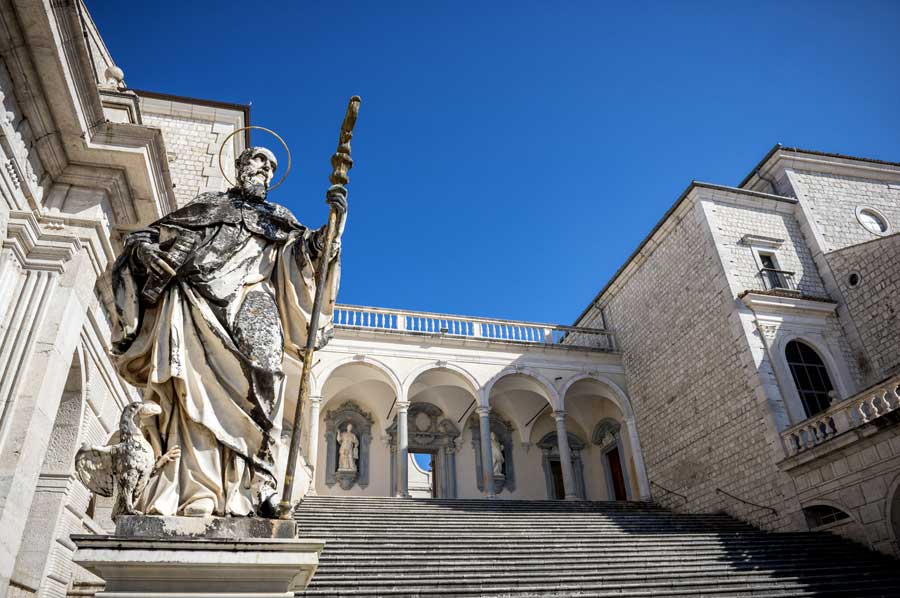
Monasteries – You don’t have to be a Christian. You don’t even have to be a religious or spiritual person of any kind to appreciate the aesthetic appeal of monasteries. It is purely a matter of an eye for architectural beauty.
It is about appreciating complexes that have stood for over a millennium in some cases buildings constructed out of religious devotion, yet whose every stone represents a profound tribute to the art of building itself, quite apart from the actual art paintings, sculptures, stained glass, and more housed within them. Italy, being a deeply Catholic country, offers a veritable cornucopia of this magnificent sacred architecture ranging from sites still serving their original purpose to those that have been secularized. Here, we present the most beautiful among them.
Pictured: Monasteries, in particular, are repositories of architecture and art that often span centuries or even millennia. And Italy lies at the heart of it all.
The Monasteries at Montecassino
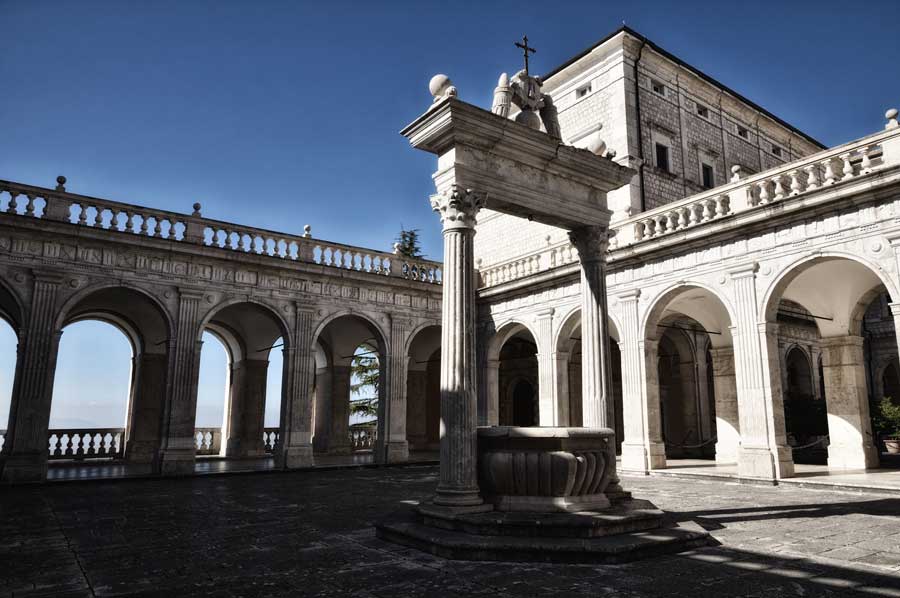 The Benedictine Abbey of Montecassino is more than just a beautiful monastery. Located in the province of Frosinone, the complex is the quintessential monastery. It was founded in 529 by Benedict of Nursia. The hermit now venerated as a saint established the monastery and the Benedictine Order (one of the most important religious orders of all) at this site; it was also here that he wrote the *Rule of Saint Benedict*, a document outlining the code of conduct for monastic life that remains in effect to this day.
Pictured: Although completely destroyed during the war, the Abbey of Montecassino has been restored to its former glory.
The abbey as it stands today is, in fact, a reconstruction. For although the site was partially or even completely destroyed several times throughout its history by violence or natural disasters, the worst devastation dates back to 1944. Montecassino occupies a strategically important location; consequently, it became a German stronghold against the Allies advancing from southern Italy and was utterly destroyed by aerial bombardment.
However, thanks to surviving architectural plans, the complex has stood since 1955 just as it appeared before that devastation: a five-square-kilometres site featuring buildings that offer an attractive blend of Renaissance and Baroque stylistic elements. It boasts a world-famous cloister and offers breathtaking views of the surrounding landscape.
Monasteries near Badia a Coltibuono
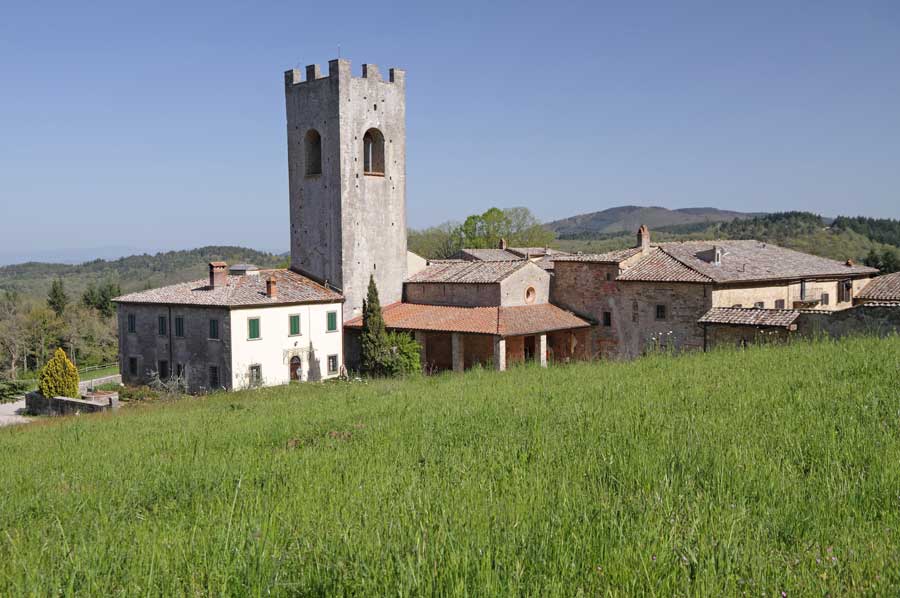 Badia a Coltibuono the "Abbey of the Good Harvest" proves that a secularized monastery need not lose any of its original allure. Located in the Chianti region of Tuscany, this Benedictine monastery is fast approaching its thousandth anniversary, with construction having begun in 1051.
Throughout the monastery's history, its name has truly reflected its character: the surrounding land is exceptionally fertile, yielding outstanding harvests of grapes and olives. This remains true today; the estate produces a highly sought-after wine, and its private history is an adventure in itself.
Pictured: Although secularized over 150 years ago, Badia a Coltibuono bears no outward signs that it is no longer a monastery, but rather a wine estate.
But how did this privatization come about? As was often the case with European monasteries, it was the result of forced secularization under Napoleon. In 1810, the Benedictine monks were expelled and the property was auctioned off; it eventually passed into the hands of the Stucchi family in 1846 the same family that owns it today. And although Coltibuono is a high-performance winemaking estate today, the owners have never compromised its architecture. The entire imposing Romanesque structure retains the appearance of a monastery, just as it did in the past. Moreover, by carefully tending the gardens, the Stucchi family has ensured that the estate remains a tourist gem; from the outside, there is virtually no sign of wine production, while the interior preserves a wealth of monastic art.
Sacra di San Michele
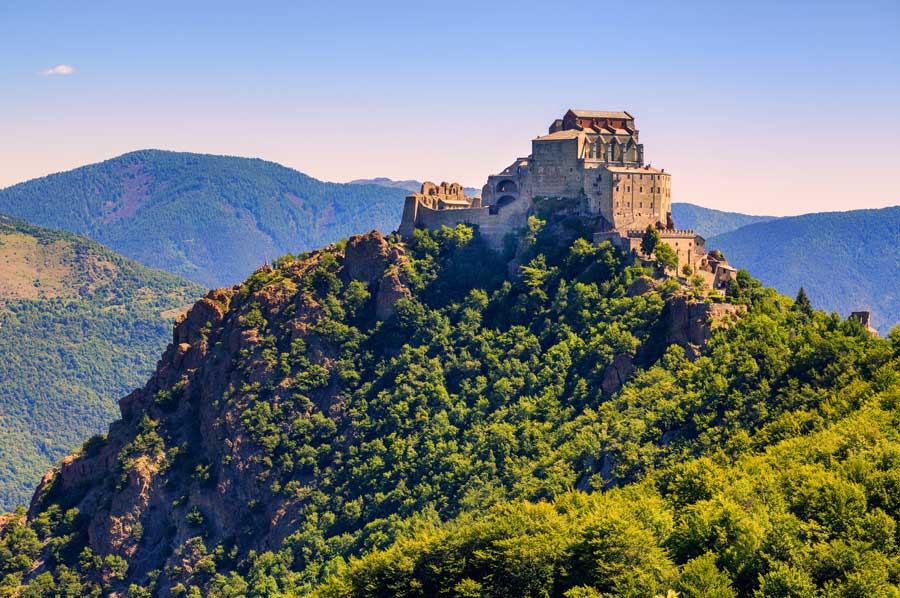 In terms of sheer grandeur, the Sacra di San Michele in Piedmont is arguably the standout entry in this article. Founded in 983, the Benedictine abbey resembles a rugged medieval fortress—an impression heightened by its location atop Mount Pirchiriano. It is surrounded by the Susa Valley, which is in turn dominated by even higher mountain ridges. A true feast for the eyes...
Pictured: Prayer and work in seclusion from the world. At Sacra di San Michele, this principle is vividly illustrated by the abbey's location.
...a quality that continues seamlessly into the complex's interior. Although Benedictine monks no longer reside there the monastery now belongs to the Rosminian order it remains a monastic building. This is evident in its architecture, which reflecting the era of its construction features an incredibly impressive blend of Late Romanesque and Early Gothic elements.
It comes as no surprise, then, that the monastery served as the exterior setting for the film adaptation of the world-famous novel *The Name of the Rose* (the interior scenes were shot at Eberbach Abbey in Germany). This makes perfect sense, as the interior of Sacra di San Michele is austere, even by monastic standards. However, a fire in January 2018 dealt a severe blow; it caused extensive damage, and restoration work is still ongoing a sobering fact, considering that *The Name of the Rose* also concludes with the abbey engulfed in flames.
Certosa San Lorenzo di Galluzzo
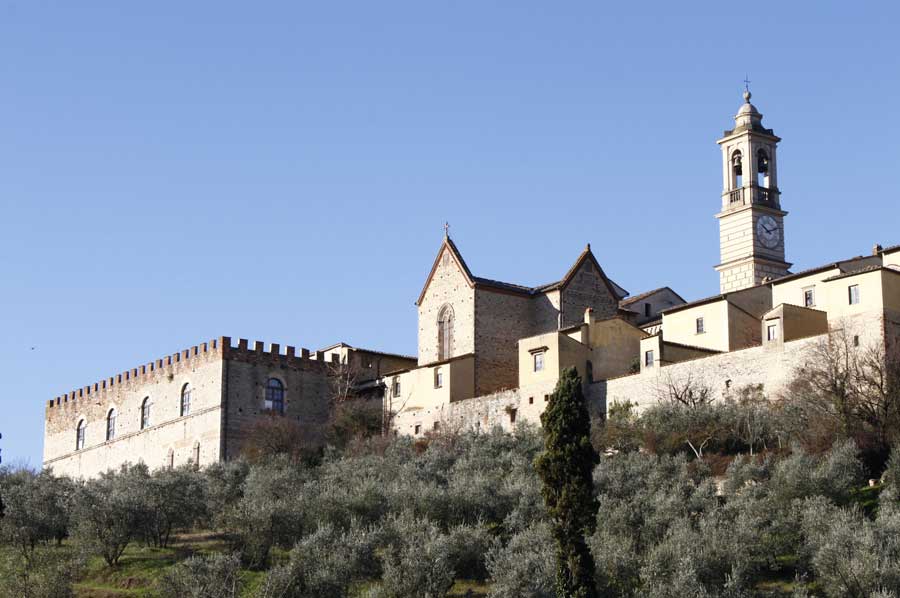 A monastery is not always founded and then remains in the hands of a single order throughout its entire existence (as was the case with Montecassino) or becomes secularized (like Coltibuono). This is particularly true of the Certosa San Lorenzo di Galluzzo monastery, located in Galluzzo a suburb of Florence as it illustrates how a change of ownership can unfold.
Pictured: A change of ownership is possible even for monasteries in the case of Certosa San Lorenzo di Galluzzo, to the benefit of all visitors.
Founded in 1342 and operated by the Carthusian Order until 1985, the site remains a monastery today though no longer a Carthusian one. How did this happen? In 1958, the abbey passed into the possession of the Cistercian Order; quite simply, it was sold. Yet what might seem like a trivial detail to the modern reader is actually the very reason the monastery made this list. It was the Cistercians who ensured that both the art treasures and the complex itself became and remain accessible to the public.
And for that, we can be grateful. The architecture of Certosa San Lorenzo di Galluzzo belongs to the Mannerist style a distinctive Italian form of the Late Renaissance. This is evident, for instance, in the dramatic ceiling paintings adorning the chapel vaults and in the incredibly intricate relief figures in the cloister. Here, too, the description "a feast for the eyes" is more than deserved.
San Giorgio Maggiore
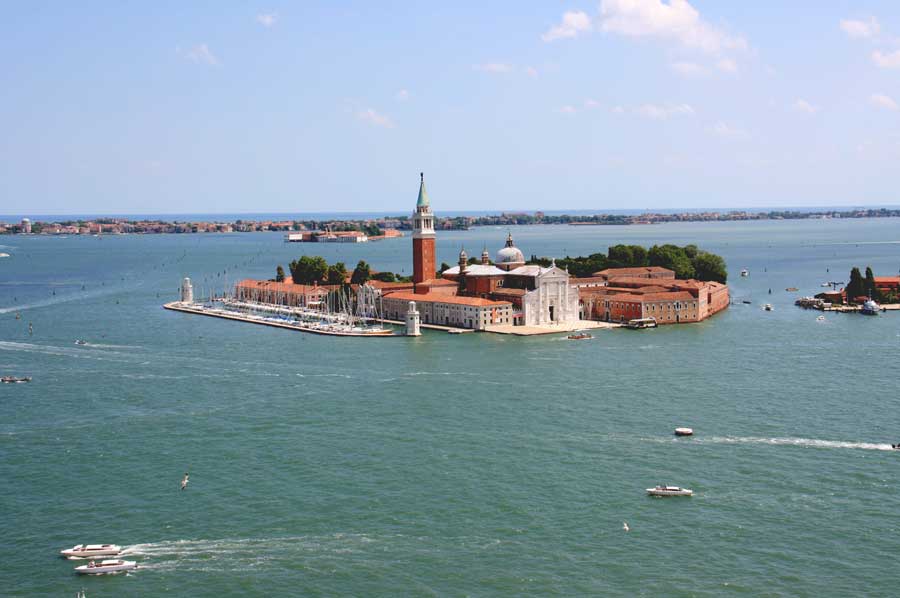 For the final monastery in this article, we travel up the Italian peninsula to the Veneto region specifically, to the heart of the Venetian Lagoon. For it is here that one finds not only the world-famous city on the water but also the monastery of San Giorgio Maggiore.
It is worth visiting if only because it occupies an entire island dedicated exclusively to the monastery. The Benedictine abbey and all its associated buildings cover the small island of the same name in its entirety. This has been the case since 982, although it should be noted that the basilica was built "only" in 1610. Pictured: Thanks to its location in the Venetian Lagoon, San Giorgio Maggiore is certainly no hidden gem, yet it is a must-see on any visit.
One could highlight the complex’s impressive architecture a true prime example of the Renaissance style or sing the praises of the interior design, with its strict white-and-grey palette that further emphasizes the building's grandeur. Yet, what makes the San Giorgio Maggiore monastery truly unique is, above all, its wealth of art treasures. Here, one finds the elaborately decorated tombs and monuments of two Doges the rulers of the once-independent and immensely powerful Republic of Venice. These are complemented by ornate statues depicting the biblical Evangelists, along with dozens of other paintings and sculptures, effectively turning the monastery into a "collection of artworks within a work of art."
Please also read:
Motya – Sacred Baal Pool, not an inland harbour
St. Nicholas Church, Potsdam – what is there to do?
Image sources:
1) fotolia.com © Massimo Santi
2) fotolia.com © Marta P. (Milacroft)
3) fotolia.com © Malorzata Kistryn
4) fotolia.com © Boris Stroujko
5) fotolia.com © antocorte
6) fotolia.com © YuricBel