


Trier - Porta Nigra, Imperial Baths, and Basilica
- Written by Portal Editor
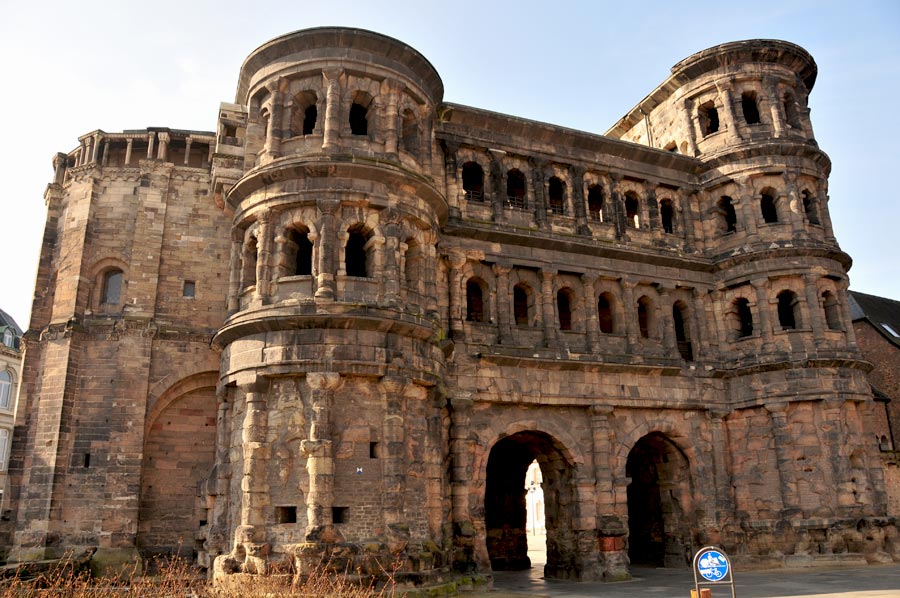
Trier - Coming from Brussels, we take the motorway via Luxembourg to visit Trier, one of the important cities of the Roman Empire and perhaps one of the key locations in our "Cultural Journey along Roman Roads."
Our friend Patrick from Strasbourg has a small van converted into a campervan, equipped with many technical features that allow for comfortable overnight stays and even the possibility of making coffee on the go.
Trier Porta Nigra - Starting Point for Exploring the City
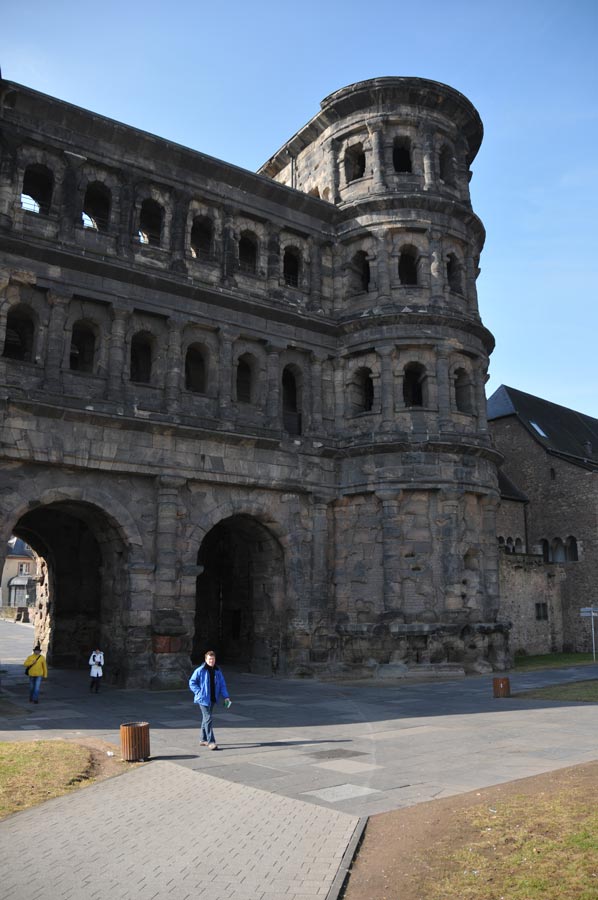 Just outside the city center, we find a free parking space and follow the small Trier city guide into the center. Naturally, our first stop is probably the most famous structure from Roman times, the Porta Nigra.
Located right in the heart of Trier, the Porta Nigra offers the best starting point for exploring the city and is also probably the best-preserved Roman city gate north of the Alps.
Built around 180 AD, the Porta Nigra is constructed from stone blocks weighing up to 6 tons, which were fitted together without mortar and held in place only by iron clamps.
After the iron clamps were inserted, the cavities were filled with lead. The stone blocks themselves came from the sandstone region of the nearby Kyll Valley, where they were cut to size using bronze saws.
Porta Nigra - Incorporation of two churches into the city gate
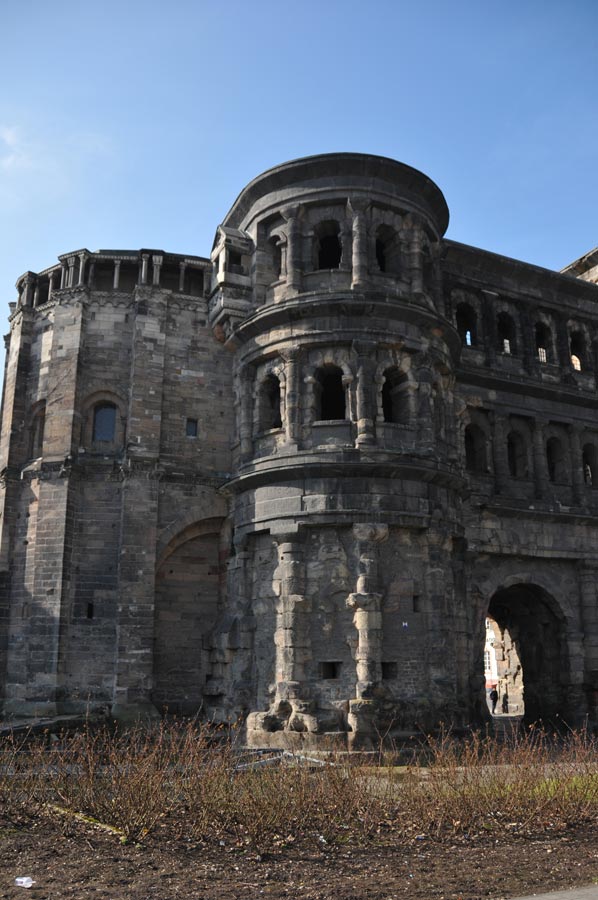 When viewing the Porta Nigra from the outside, one can partially see traces of rust on the clamps caused by rainwater seeping in. During the Middle Ages, some of the clamps were chiseled out and stolen by metal thieves.
Since a Greek monk had himself walled up as a hermit in the east tower of the Porta Nigra in 1028, the Porta Nigra was spared the fate of being a readily available source of building materials. All too often, ancient buildings served as a source of free building materials.
With the death of the hermit in 1035 and his subsequent canonization and burial on the ground floor, the building's destruction was finally halted. Archbishop Poppo von Babenberg even had two churches built into the city gate, which were only demolished again with Napoleon's arrival between 1804 and 1809.
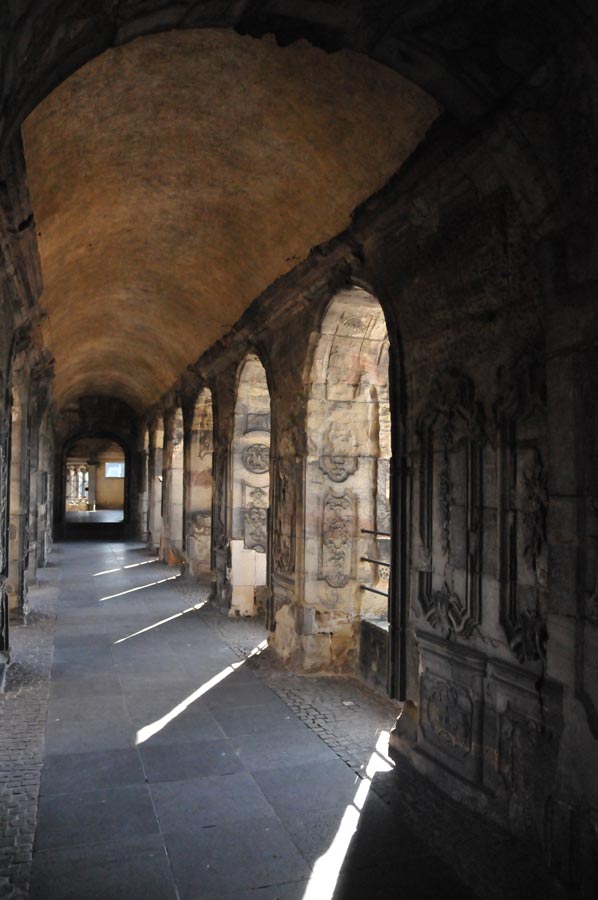
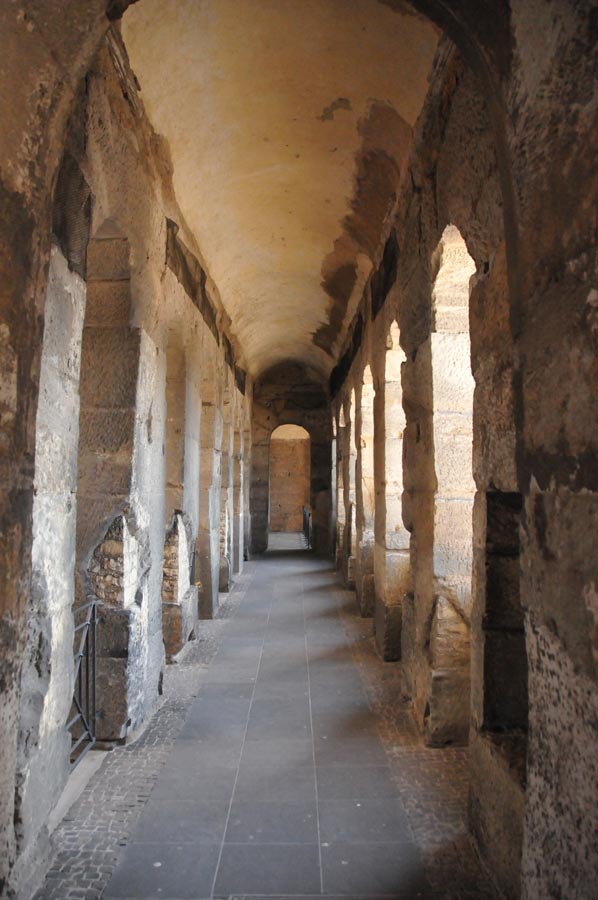 Many historical traces of alterations can still be clearly seen inside the Porta Nigra. The marks of the former chiseling work for the beams, complete with stonemasons' marks and dates, are clearly visible.
On the exterior of the building, the effects of modern times are clearly visible, as environmental pollution has turned the stones almost black, which is why it is now also called the "Black Gate."
Every Saturday, a guided city tour starts at the Porta Nigra and is led by a Roman centurion in period clothing.
During the peak tourist season, the tour also takes place several times a week.
Trier - Pedestrian Zone to the Basilica of Constantine
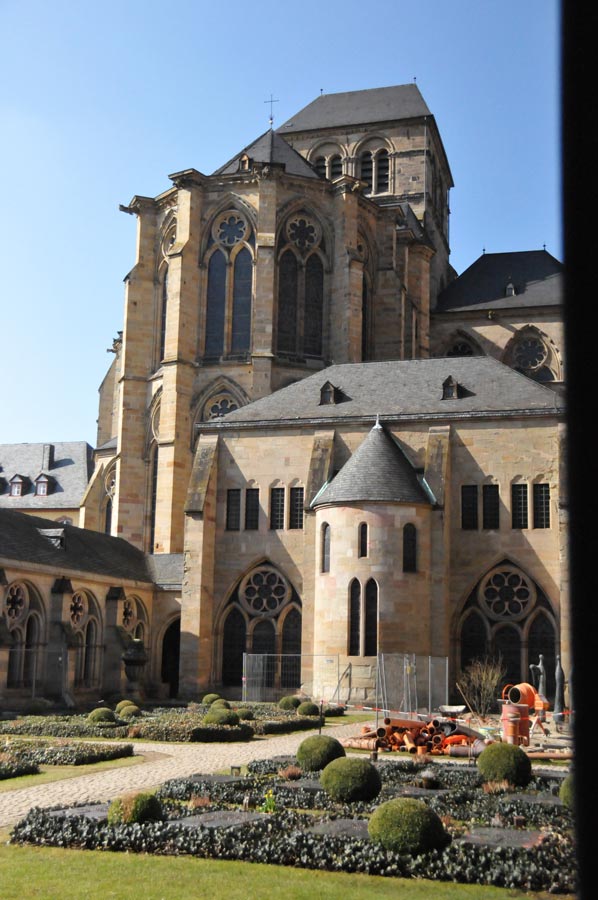 Our route leads us through the beautiful pedestrian zone, framed by numerous historically valuable buildings, to the Basilica of Constantine.
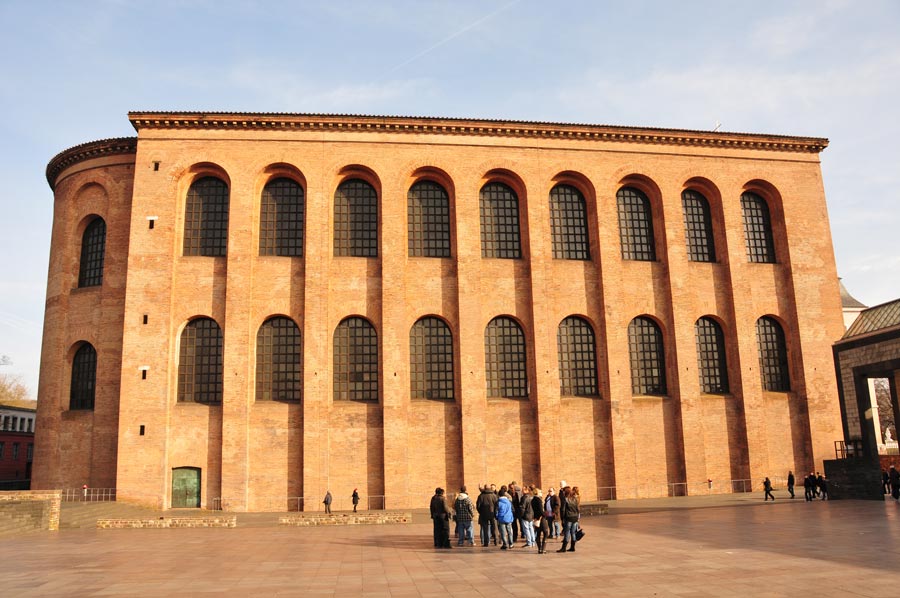
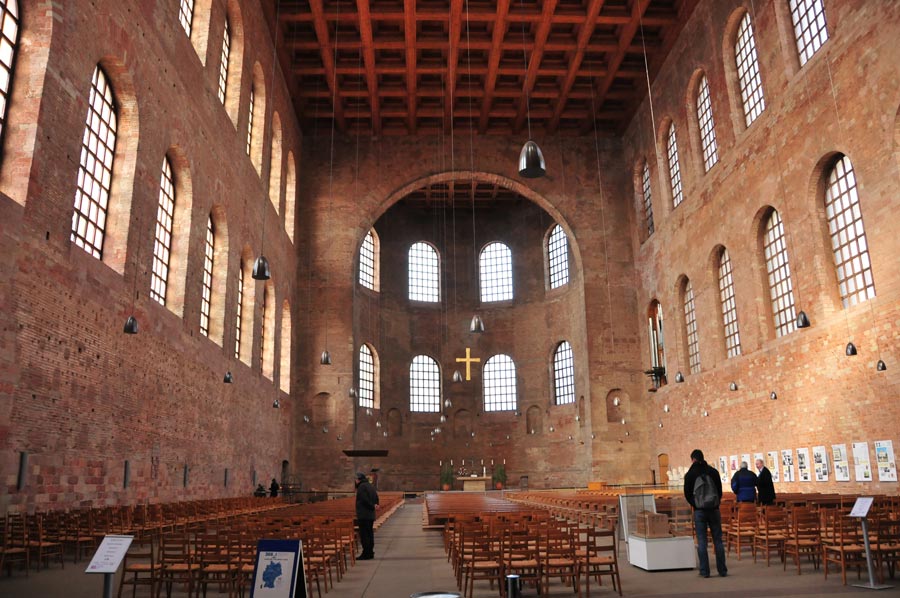
As one of the largest surviving single rooms from antiquity, the so-called basilica is used as a church today.
The building, originally constructed as the throne room of Emperor Constantine, showcases the emperor's grandeur and power in an impressive architectural design: a free-standing, large hall with a 7-second reverberation time, likely unique in the world.
The building's dimensions are also imposing: 27.2 meters wide, 67 meters long, and a proud 33 meters high.
 Several optical illusions employed by the architects of the "Aula Palatina" further emphasize the effect of its size. For example, the windows of the apse and the niches below them become smaller towards the center, creating a perspective distortion that makes the space appear even longer.
During the Roman rule, the entire building was lined with marble, featured mosaics and statues, and was equipped with underfloor heating in the hypocaust system of many Roman buildings.
When the Franks seized power in Trier in the fifth century, the architecture was destroyed, and the now roofless basilica was used to establish a small village within its walls.
From 1614 onward, three palace wings were added in the Rococo style, and from the mid-19th century, the Basilica of Constantine was converted into the first and thus oldest Protestant church in otherwise Catholic Trier.
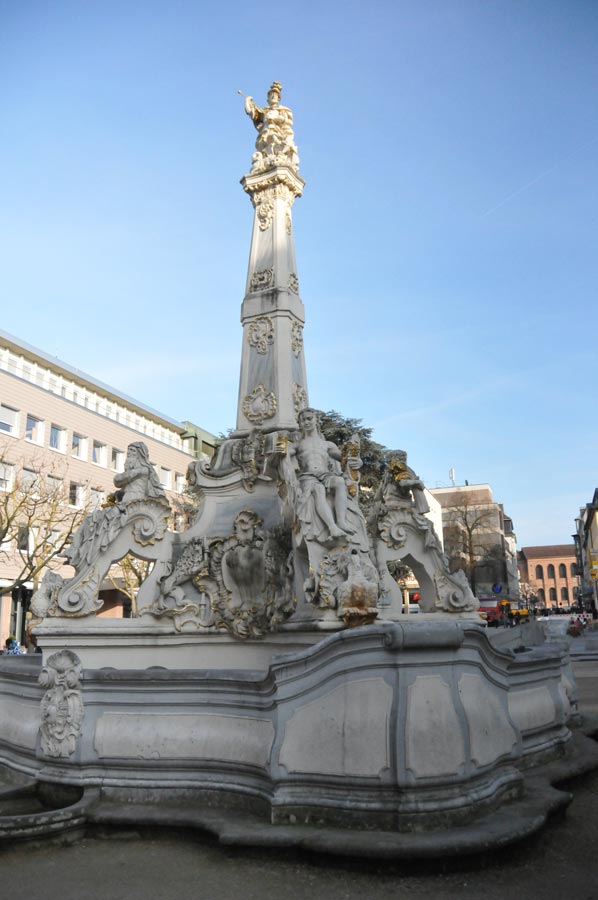
 Around 2:00 p.m., we had arranged to meet with Mr. Thomas Weinand from EIC Trier to present our project in detail and exchange any further information.
We met at the Porta Nigra right on time and chose an Italian ice cream parlor with delicious cappuccino as the meeting place.
This exchange of information laid the foundation for further cooperation regarding project design and, above all, its technical description and explanation.
This assistance could prove invaluable to us.
 Our route then took us through the old town to another of Trier's attractions: the Imperial Baths. Construction of the Imperial Baths in Trier, which began in the 4th century AD, made them one of the largest bathing complexes in the entire Roman Empire.
Even though only a few remnants of the original surrounding walls remain, their size and monumentality are still impressive.
Both above and below ground, the significance and design of Roman baths can be readily appreciated.
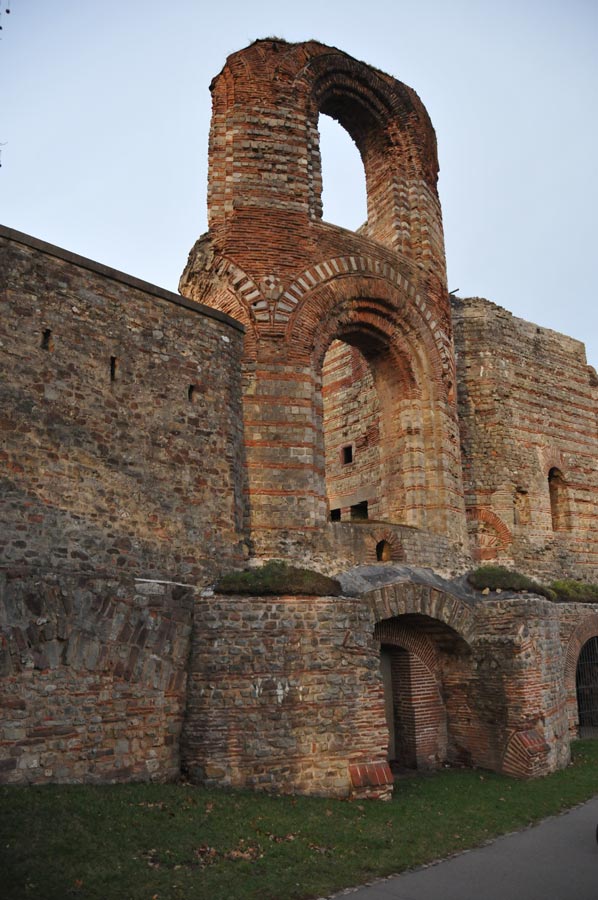 While only the area of the former "caldarium," the warm bathing hall, is still recognizable, it now accommodates up to 650 people for theatrical performances.
A total of six boiler rooms were used to heat the incoming water, of which only four are still visible. The heated water was also used to warm the other covered rooms, which were heated by underfloor heating. Even today, one can walk from the caldarium through the underground passages to the cold bath (frigidarium).
About 500 meters further uphill lies the amphitheater, which could hold approximately 20,000 spectators and was built around 100 AD. The builders took advantage of the natural slope of the Petrisberg hill to construct grandstands for the spectators.
 The excavated earth was then used to build more grandstands on the opposite side. Only the entrances were constructed as stone portals. The entire arena was surrounded by stone walls with openings leading to underground stone chambers. These chambers housed the people and animals that would later perform their combats in the arena.
Further investigations suggest that at least part of the arena floor functioned as a lifting platform. The beams of a piston pump, which drained the structure into the Olewig stream, are still visible today.
These were originally used to drain the arena into the Olewig stream. Trier - Moselle Bridge from 16 BC
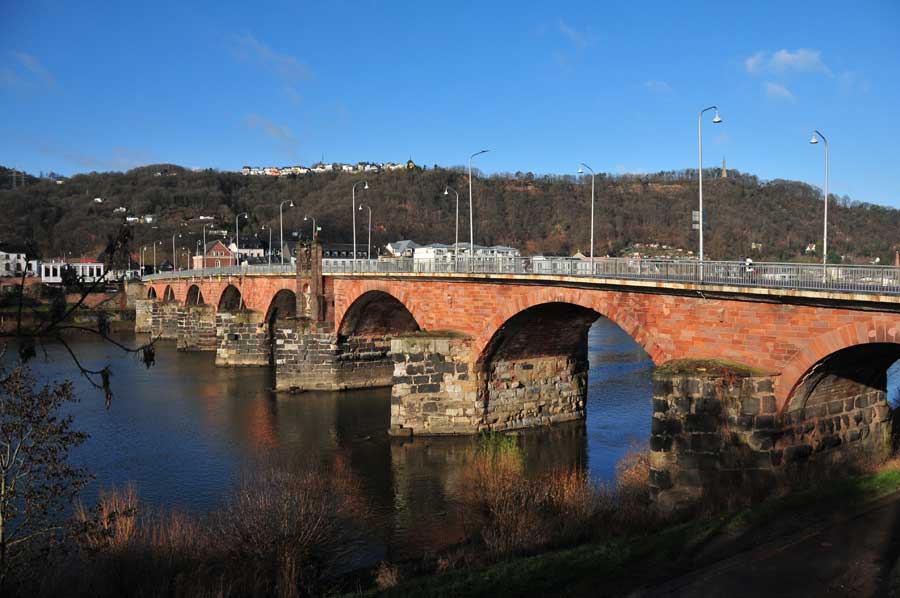
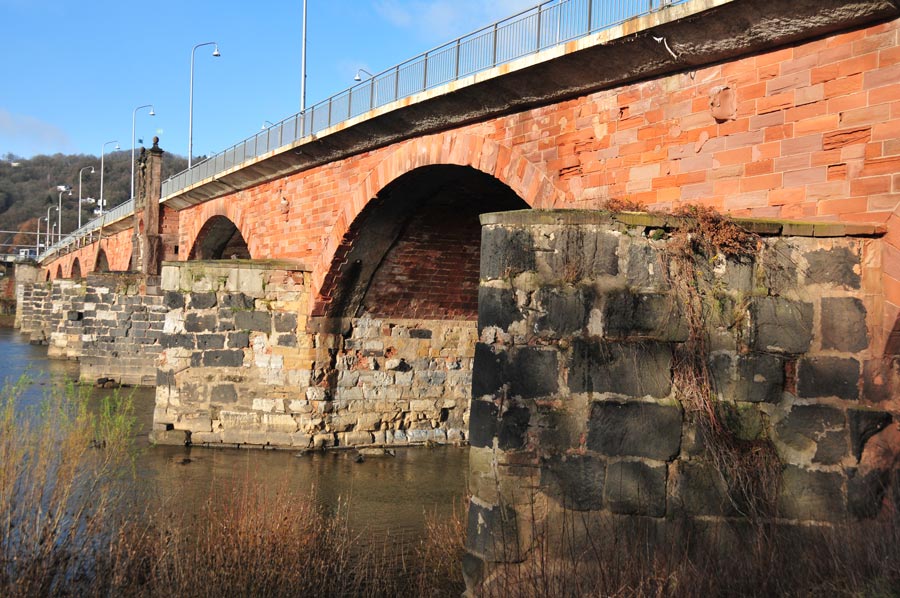 Other interesting Roman structures include the Moselle Bridge, dating from the founding year of the city of Trier around 16 BC, and the Barbara Baths from the 2nd century AD. The Trier Moselle Bridge is the oldest Roman bridge west of the Alps that, even after more than 2000 years, still withstands modern traffic.
Investigations into the bridge's foundation piles revealed that the oak trees were felled in 16 BC. In 71 AD, massive beam rings were added, serving as foundations for the stone piers.
 Of the seven existing piers, five date directly back to Roman times. Between 144 and 152 AD, cast masonry cores were constructed and faced with basalt lava stones. These stones, up to three meters long and between 35 and 95 centimetres high, serve as facing and protection against ice floes, having been cut into wedge shapes on the upstream side. The stones are joined together with iron clamps, similar to those at the Porta Nigra, which were cast with lead. The wooden roadway was then built on top of this pillar structure. The stone arches visible today date from a later period and were erected by Elector Baldwin of Luxembourg.
The Barbara Baths once measured 172 x 240 meters and were thus, at the time of their construction in the 2nd century AD, the second largest bath complex of their time after the Baths of Trajan in Rome. Unfortunately, only the reconstructed underfloor heating system and a few passageways leading to the former fireplaces remain.
Please also read: