


Ernst E. Hirsch – A German Legal Scholar in the Land of Atatürk
- Written by Portal Editor
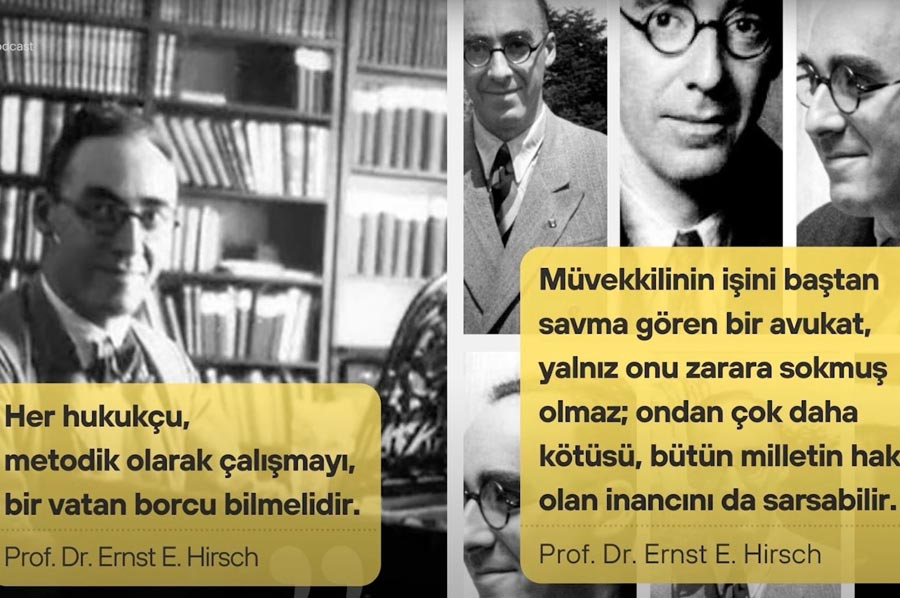
Ernst E. Hirsch – The legal scholar Ernst Eduard Hirsch was born on January 20, 1902, in Friedberg, Hesse.
At the universities of Frankfurt and Munich—institutions of great renown even at that time—Hirsch studied economics and law, earning his doctorate in 1924. Further studies followed at the University of Giessen, culminating in his habitation in 1930.
Following his studies, in January 1931, Hirsch was appointed District Court Councillor in Frankfurt—a position that simultaneously granted him tenure as a judge for life.
Due to his Jewish heritage, Hirsch was dismissed from his post in late March 1933—an event he himself described as the "Day of German Shame," for it was on this day that the Nazis issued their call for a boycott of Jewish businesses. Like many other prominent figures (such as Ernst Reuter), Hirsch received an invitation from the Turkish government to assist in the reconstruction of Turkey based on new principles; in Ernst E. Hirsch’s case, this entailed taking charge of establishing the newly founded Chair of Commercial Law at the University of Istanbul.
After initially emigrating to the Netherlands, Ernst E. Hirsch arrived in Turkey in October 1933. It was a decision that likely saved his life, as many of his acquaintances and relatives perished in Nazi concentration camps. His contract at the University of Istanbul—initially limited to a five-year term—stipulated that, for at least the first three years, Hirsch would be permitted to lecture in German with the aid of a simultaneous interpreter; this arrangement made his transition into the role significantly easier. His lecturing style—which involved challenging students with questions—combined with his initially somewhat halting Turkish, proved to be early obstacles to his acceptance by the student body. Yet, before long, he was being welcomed at the start of each lecture with thunderous applause from his students—and sent off with the very same ovation. After his third year, Ernst E. Hirsch was required to deliver his lectures exclusively in Turkish. By this time, even the dean had grown accustomed to his lecture style—characterized by direct student engagement—so that Hirsch soon rose to become a prominent figure, and his popularity within the university steadily increased. In 1943, Hirsch transferred to the University of Ankara, where he taught legal philosophy, legal sociology, and legal methodology. After nearly two decades—during which he acquired both Turkish citizenship and civil servant status under Turkish law—Hirsch concluded his work in Turkey in 1952.
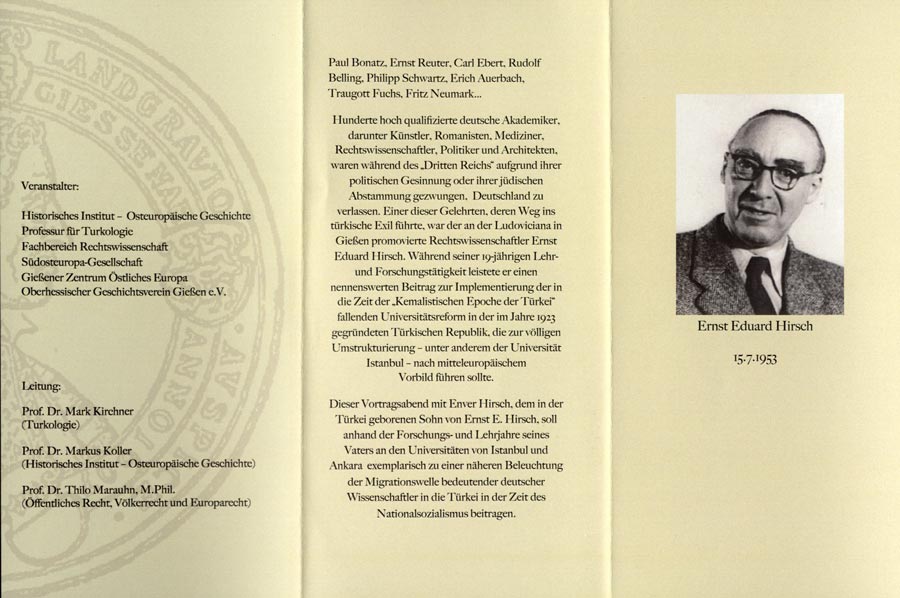 It is largely thanks to him that the Turkish legal system and higher education sector are so strongly modelled on Western precedents. Even today, his works remain standard texts in the training of Turkish legal professionals; furthermore, he drafted legislative bills and conceptual frameworks for the Turkish Commercial Code, the Stock Corporation Act, the University Act, and legislation concerning copyright and inventors' rights.
Since Ernst E. Hirsch had been stripped of his German citizenship by the Nazis, he initially had no desire to return to Germany. It was only through the persuasion of his colleague Ernst Reuter—himself a former émigré in Turkey who had since been elected Mayor of Berlin—that Hirsch was convinced to accept a professorship at the Free University of Berlin; there, between 1953 and 1955, he was elected Rector. At this time, Hirsch also had his German citizenship restored. In 1958, in the Turkish daily newspaper *Yaman*, the Turkish journalist Ahmed Emin Yalman wrote the following regarding Hirsch:
“After the twenty years he has spent in Turkey, Professor Hirsch has become completely one of our own. He may be a very good German, but he is undoubtedly, to an equal degree, a good Turk.”
— Abridged New Edition: *Als Rechtsgelehrter im Lande Atatürks* [As a Legal Scholar in the Land of Atatürk], Berliner Wissenschafts-Verlag, 2008 (ISBN 978-3-8305-1533-3)
Please also read: