


Coins - Minting and Production Through the Centuries
- Written by Portal Editor
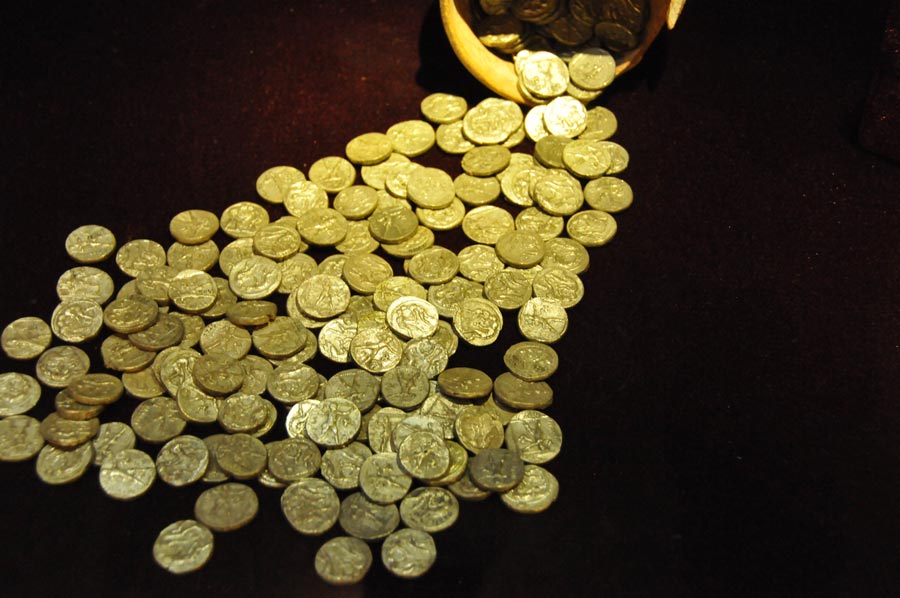
Coins - In our recent article "History of Coinage as a Means of Payment," we discussed the history of coinage. The question remains: what techniques were used in coin production?
The first coins were made from electrum in the 7th century BC, a naturally occurring gold-silver alloy found in lumps in riverbeds. This was roughly worked with a hammer, and then simple designs were struck or punched into it using a chisel-like tool.
The coins of this period were mostly misshapen, just as they appeared in nature, only slightly flattened. With advancing technology, the designs became more precise and artistic. From around 650 BC, skilled coin makers were able to simply stamp motifs such as a lion's head into the blank. Gradually, coin minting developed into a distinct craft that continued to evolve for centuries, resulting in coins that were more artistic and graphically sophisticated, ultimately becoming highly sought-after collector's items in addition to their use as currency.
Around the same time, a second technical component emerged, known as die-making. This involved utilizing the different hardness of metals to shape a softer metal using a harder metal. For this purpose, a lower die was made of iron, into whose surface a design was carved. The technique of creating a negative image was relatively quickly mastered, allowing the positive image to be transferred to the coin. The same process was used for the upper die. Both dies, referred to in Greek as "character" for the lower die and "typos" for the upper die, were then hardened through transmutation in fire, a process in which the ferrous iron present at room temperature transformed into austenitic iron through the incorporation of more carbon. This hardening process was already known from the manufacture of weapons.
The lower die was then set into an anvil or a wooden block. The coin blank, which could be made of various materials such as gold, silver, copper, or an alloy, was placed as a metal disc onto the lower die, and the upper die was then placed on top. This required absolute precision from the minter, who had to align both dies perfectly to produce an exact coin. The upper die was then struck with a hammer, and the impact created the positive image on both sides of the blank. These blanks for coin minting were also called planchets or flan. As technology improved, the edge of the coin was also engraved into the die, so that the impression after striking included the shape of the coin, regardless of its size.
Over time, silver became increasingly prevalent in coin production; copper remained only for subsidiary coins, a practice that persists in some currencies to this day. The designs on coins also became increasingly refined, making it possible to depict the respective rulers on their coins. However, this only occurred after the time of Alexander the Great. The Romans often used bronze for their coins, and in addition to portraits of their rulers, they also depicted mythological scenes, cityscapes, and even artists and scholars. Silver coins were rare among the Romans.
Of course, minting coins was not permitted for everyone; it was the prerogative of certain cities where coin minters settled and were allowed to practice their craft on behalf of the state.
To this day, the minting process has only changed insofar as mechanical striking devices are used instead of hammers. The artisanal coin minter has evolved into a graphic designer working on a computer, who designs the dies and then has them milled using CNC technology.
Please also read: