






























Roman Thermal Baths and Baths in Antiquity
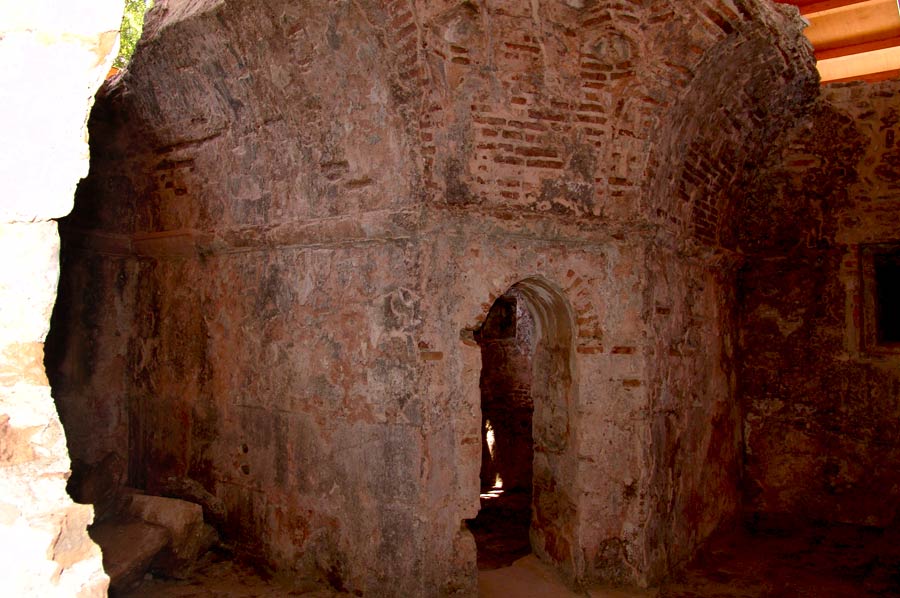
Involvement of human beings with water goes back to earliest days of history. In the prehistoric ages, prior to the transition from nomadic existence to forming permanent settlements, water usage was partially a part of nature that could not be controlled.
In other words, prehistoric humans did not try to create the conditions for easy usage of water and water resources.
The matter of water was considered if and only if after the humans began to form permanent settlements and proceeded to a new stage and therefore began agricultural activities.
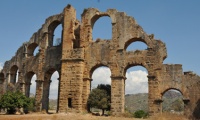
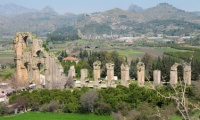
Water was much needed in the new settlements and this need could only be met from the local water sources. So many problems there were that they could only be solved by multi directional ideas and intelligence. Technicians of each era were increasingly responsible for finding and utilizing new resources and reserves. The water had to be stored and fast served for the use of constantly increasing population (See Antique Roman Aqueducts in Aspendos, Oymapınar - Side). The new problem of discharge of waste water was another matter to be dealt with. Indeed, large scale planning and structuring relating to utilization of water accompanied the development of civilizations right from the very beginning. Peoples of the antiquity did not infact have solid or advanced scientific knowledge of physical and chemical characteristics of water. Involvement with water was mostly intuitive. In other words, “taming” of water was more and art than science.
Evolution of Thermal baths
Especially in the Roman era, as the technology gradually advanced and the physical characteristics of water was discovered, a real water culture evolved. In parallel though, tasks related to water utilization was constantly multiplying. Moreover, the requirement of hygiene in constantly growing cities was not the only element in such tasks. Upon construction of aqueducts, water could be used anywhere and anytime within the lands of Roman Empire. As such, the idea of constructing public baths for the purpose of body cleansing emerged. The first of such structures were the small, primitive bath rooms named Balnea. However, they served their purpose perfectly. The idea of public baths and smaller facilities became absorbed by Roman Culture in about 300-200 BC. The Stabia Baths in Pompeii are one of the oldest examples of public baths and the first phase of building such facilities goes back to 3. B.C.
When the concept of baths had become a relatively developed element in the middle of year 1, Young Seneca, the Roman philosopher wrote: “In the early days, however, there were few baths, and they were not fitted out with any display. For why should men elaborately fit out that which costs a penny only, and was invented for use, not merely for delight? The bathers of those days did not have water poured over them, nor did it always run fresh as if from a hot spring... Ye gods, what a pleasure it is to enter that dark bath, covered with a common sort of roof, knowing that therein your hero Cato, as aedile, or Fabius Maximus, or one of the Cornelii, has warmed the water with his own hands!”
It is clear from these notes that critics on bathing habits were born amongst Romans who became seekers of utmost comfort as the time passed. Slowly, larger and “real” thermal baths began to be constructed instead of small and dark bath rooms. However, we must add here that there are no remains left from the first samples of Roman bath rooms but Baths of Agrippa, the larger Roman thermae, constructed in about 20 BC is a fine sample of architectural development of thermal baths, although we do not see the later symmetry as yet. The aqueduct Aqua Virgo was recently completed and the problem of water supply to baths was solved. From what we can gather, operation of public baths had become possible upon construction of this waterway because, the baths consumed huge amounts of water. Baths of Agrippa are thermae that is defined as terraced baths. The definition refers to the sequence of the rooms. However, it is still not proven concretely that the Baths of Agrippa were in fact such type because we do not have the opportunity to compare the style with that of the classification we have on thermae in the Mediterranean region.
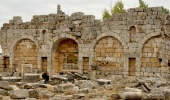
Antique period architects were sometimes left free to design the thermal baths. It would indeed be proper to think that this is the reason why we have different styles of architecture in bath construction. Many experts consider this tendency to be the transition period of bath architecture. The thermae constructed in this transitional phase are usually not large and without display and although they serve their purpose, are not as luxurious as the later samples. It is possible to see samples of this transitional period at the antique settlements of Perge / Antalya, Hierapolis / Denizli, Ilyasbey / Miletos, Seleukeia / Manavgat, Salamis / Gazimağusa. The excavations in those ruins have shown the Hypocaust Central heating technique to be widely used. Majority of the thermae constructed at the later stage belong to last stage of development, including Imperial Baths.
As the Roman Empire prospered, the technology and construction methods available for the engineers resulted in creation of monumental structures. Of course, the competition between the succeeding Roman Emperors was a determining factor as well. Conquering of new lands was not sufficient to symbolize their power. It was their ambition to construct larger and monumental baths, which we could interpret as a social ambition in terms of public life. As such, many of the thermae constructed at the time of Roman Empire carry the name of the emperor who had it built.
Nero’s Baths near Baths of Agrippa is a finer sample of thermae constructed using advanced techniques. First example of Imperial baths can bee seen there. An Imperial bath consists of a facility aligned to an axis and a sequence of rooms added to the main hall. The dimensions of overall structure also significantly increased in this style of architecture and as a result, reached to monumental scales. A characteristic sample of such thermae facility can be seen in Sart / Manisa ruins. One can see that the walls were covered with marble blocks – despite technical difficulties- and the floors were ornamented with mosaics and the structure gives us the opportunity to examine the day’s architecture. Most striking in the Imperial style is the generous use of luxury fittings and the monumental scale of the buildings.
Culture of Bathing
Now that we had a good look at the architectural and technological features of Roman Culture of Bathing, let’s have a look at the social and cultural implications of thermae. Roman urban development had a primary and superior role in antiquity. No other culture has exhibited such planning and pragmatism in this sense. In addition, this has been the case for many cultures around the world until about 18th century. The attraction that Roman urbanization has could be attributed to the unique technical and cultural development their cities have shown. At an earlier stage, the citizens of Roman cities had already become used to a specific standard in terms of utilization of water. For that reason, it is not surprising to find that to the Roman citizens, existence of many thermae and baths were only normal. Ordinary citizens generally used “Private bath for rent” (Balnea Meritoria). Not as luxurious as some larger ones, Balnea Meritoria were mostly constructed by private entrepreneurs and run for profit. It is possible that they were built smaller due to the costs involved in running them because the owners were not as rich as the Emperors or the army commanders.
Another type of baths were the public baths (Balnea publica), which were small but provided the user with all that is needed for keeping clean. Public baths belonged to the state and they were operated by government officials, as was the case with other baths.
Wealthier citizens preferred to use larger Public Thermae. The entrance fee “Obulus” is thought to have been more than what was paid to Balnea Meritoria. Thermae were large bathing facilities that were constructed by and devoted to the Emperor or other wealthy individuals. They were mostly decorated luxuriously so as to allow free time activities. Representative of the beginnings of culture of bathing, there were 11 of those thermae in Rome only. Indeed, they were open to everyone but, Thermae were mostly used by citizens of a certain strata. For example, one could not see slaves in Thermae, except for those who were brought by their owners to pour water over or rub the back of their masters. Majority of the really wealthy citizens owned villas with private bath rooms. Such villas and the baths inside were generally enormous and very luxurious. As such, the household did need to go to public baths to wash.
Nevertheless, having a wash or bath were not the only activities to ensure body health. Bathing was also a recreational activity to spend time. Indeed, as the size of structures grew and the facilities inside were multiplied, bathing became a joyful activity. People met at baths to play sports, games, have fun or simply laze about. In the meantime, news circulated, contracts were signed, state officials were bribed, conspiracies and plots were devised, talks were held and rumors were spread in bath houses. Large baths, such as the Thermae Diocletianus could accommodate so many people at the same time that those places served as if communication centers. Surely, people gathered also at large esplanades to communicate but, the atmosphere was nowhere near what the baths offered. Baths provided people with the opportunities to engage in sports, wash, play games and simply enjoy their time. In addition, they were such multi purpose, attractive localities that it was even possible to take some courses or obtain medical help.
It looks like the daily lives of people in those days were very much different to our daily lives and they had more time to spend for themselves. Considering the 15 hour working day of Japanese, if we applied this tempo to the ancient Rome, it would virtually be impossible for them to utilize the baths.
As an ancient Roman idiom perfectly explains to the mortals “6 hour work is sufficient. Carpe Diem.”
Please read as well: