













alaturka

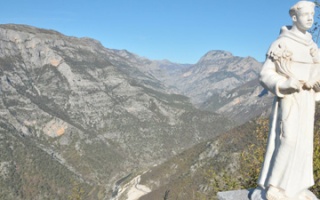
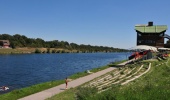
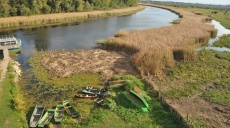
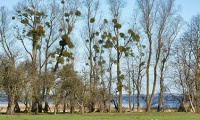
Zasavica bog - views from Farmland Zasavica

Zasavica bog - views from Farmland Zasavica

Zasavica is a bog in the region of Mačva, west-central Serbia. With Obedska bara and Carska Bara, Zasavica is one of the major wildlife refuges and one of the last authentically preserved wetlands in Serbia. In the 2000s it became a popular attracti...

  1. Literature
  2. Theatre
  3. Films
  4. Music
  5. Design
  6. Religion
  7. Education

Basilica

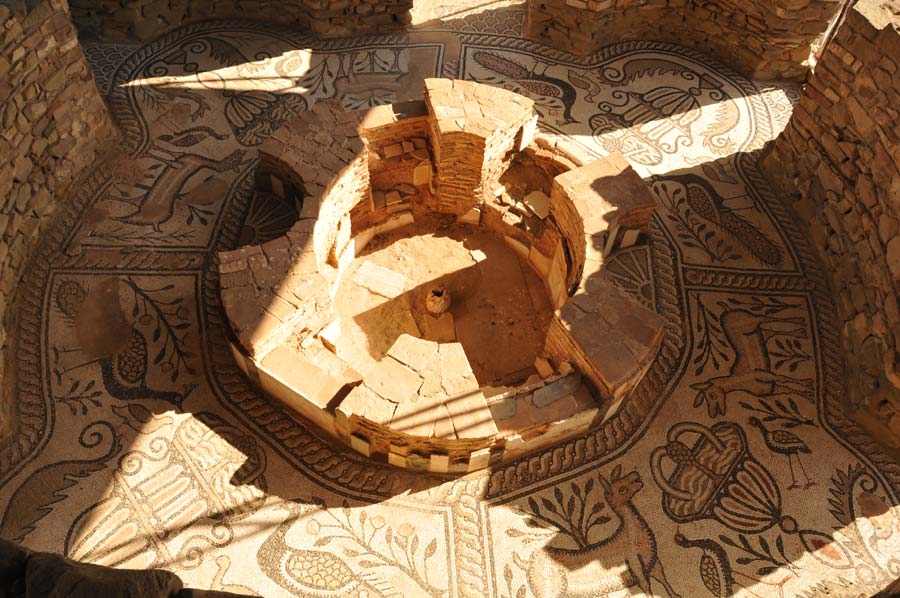
Basilica in Stobi, Macedonia

The Latin  word basilica, was originally used to describe a Roman  public building, usually located in the forum of a Roman town. Public basilicas begin to appear in Hellenistic cities in the 2nd century BC.

Basilicas were also used for religious purposes. The remains of a large subterranean Neopythagorean basilica dating from the first century were found near the Porta Maggiore in Rome in 1915; the stuccoes on the interior vaulting have survived, though their exact interpretation remains a matter for debate. The ground-plan of Christian basilicas in the 4th century was similar to that of this Neopythagorean basilica, which had three naves, and an apse.

After the Roman Empire became officially Christian, the term came by extension specifically to refer to a large and important church that has been given special ceremonial rites by the Pope. Thus the word retains two senses today, one architectural and the other ecclesiastical.
In architecture, the Roman basilica was a large roofed hall erected for transacting business and disposing of legal matters. Such buildings usually contained interior colonnades  that divided the space, giving aisles or arcaded spaces at one or both sides, with an apse  at one end (or less often at each end), where the magistrates sat, often on a slightly raised dais. The central aisle tended to be wide and was higher than the flanking aisles, so that light could penetrate through the clerestory windows.

The oldest known basilica, the Basilica Porcia, was built in Rome in 184 BC by Cato the Elder during the time he was censor. Other early examples include the one at Pompeii (late 2nd century BC).

Probably the most splendid Roman basilica  is the one constructed for traditional purposes during the reign of the pagan emperor Maxentius and finished by Constantine I after 313. As early as the time of Augustus, a public basilica for transacting business had been part of any settlement that considered itself a city, used like the late medieval covered market houses of northern Europe, where the meeting room, for lack of urban space, was set above the arcades, however.

In the 4th century, once Christianity had been decriminalized, Christians were prepared to build larger and more handsome edifices for worship than the furtive meeting places they had been using. Architectural formulas for temples were unsuitable, not simply for their pagan associations, but because pagan cult and sacrifices occurred outdoors under the open sky in the sight of the gods, with the temple, housing the cult figures and the treasury, as a backdrop. The usable model at hand, when Constantine wanted to memorialize his imperial piety, was the familiar conventional architecture of the basilicas.  These had a centre nave with one aisle at each side and an apse at one end: on this raised platform sat the bishop and priests. Constantine built a basilica of this type in his palace complex at Trier, later very easily adopted for use as a church. It is a long rectangle two stories high, with ranks of arch-headed windows one above the other, without aisles (no mercantile exchange in this imperial basilica) and at the far end, beyond a huge arch, the apse in which Constantine held state. Exchange the throne for an altar, as was done at Trier, and you had a church. Basilicas of this type were built not only in Western Europe but in Greece, Syria, Egypt, and Palestine. Good early examples of the architectural basilica are the Church of the Nativity at Bethlehem (6th century), the church of St Elias at Thessalonica (5th century), and the two great basilicas at Ravenna.
Germany – the Netherlands – Great Britain – France – Italy – Portugal

The Lessing town of Kamenz on the edge of the Sorbian region

Lessing town of Kamenz on the edge of Sorbian region

27-08-2023 | Hits:5166

Following an invitation from Claudia and Heinrich, we drove to the previously co...

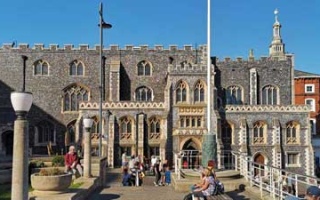
A first visit to Norwich - it will not be the last!

Norwich - A first visit - it will not be…

30-09-2019 | Hits:35744

Norwich, about 100 miles northeast of London, is arguably the most fully preserv...

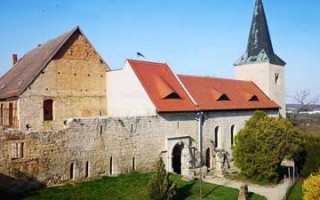
Zscheiplitz Monastery - a stopover on the Unstrut cycle path

Zscheiplitz Monastery - a stopover on Unstrut cycle path

07-04-2021 | Hits:13477

The place Zscheiplitz is located on the elevated left bank of the Unstrut within...

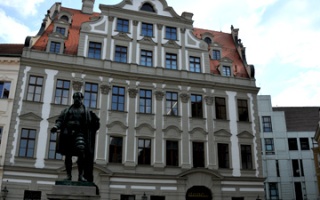
City guide Georg and the first city trip through Augsburg

City guide Georg and the first city trip through Augsburg

05-05-2022 | Hits:6060

The next morning, the owners Lydia and Georg are already away on business, we pr...

Hiking, Cycling and Motorcycle Tours

Bike Tour Lednice - with AZUB Recumbent and BTurtle

10-12-2025

Lednice - Bike Tour with AZUB Recumbent and BTurtle

Lednice Castle, which is one of the most visited monuments in the Czech Rep...

With E-bike to the Hanskuehnenburg near Braunlage

25-03-2023

Hiking Hanskuehnenburg near Braunlage by E-Bike

The Hanskuehnenburg is a managed mountain hut in the western Harz Mountains...

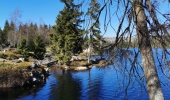
Hike around the Oderteich near Sonnenberg

08-05-2023

Sonnenberg - Hike around the Oderteich

Sonnenberg - We were on our way back from Braunlage to Clausthal-Zellerfeld...

Albania - North Macedonia - Greece - Turkey - Cyprus

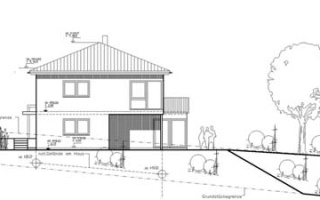
Architect and Project - a friend for different jobs

Architect and Project - a friend for different jobs

16-06-2020 | Hits:10241

Because of the rapid development in tourism and more requests for flats and vill...

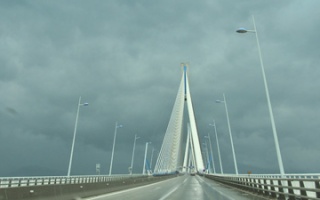
Crossing the Rio-Andirrio-Bridge to Peloponnesus Peninsula

Rio-Andirrio - Crossing the Bridge to Peloponnesus

23-09-2016 | Hits:100809

Rio-Andirrio - After our surprisingly pleasant and interesting stopover in Nafpa...

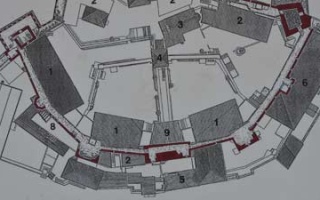
Thessalonica - Citadel and ramparts of Heptapyrgion Castle

Thessalonica - Citadel and ramparts of Heptapyrgion

21-07-2016 | Hits:39542

In the morning we had left again to explore Thessalonica, when we first moved fr...

Tour through the Kelmend into the Cem Gorge

Kelmend - Tour through the valley and to the Cem Gorge

15-11-2016 | Hits:162602

Kelmend, the northernmost part of the Albanian Alps, is mainly formed by two val...

Camper-Route

Welcome to Camping Legjenda at Shkodra - Albania

13-08-2025

Station 8 - Welcome to Camping Legjenda at Shkodra

Camping Legjenda is the ideal solution for those who want to live surrounde...

Station 41. Zugligeti Niche Kemping near Budapest

10-04-2018

Station 41 - Zugligeti Niche Kemping near Budapest

Close to the city center of Budapest and not far from the historical castle...

Poland – Czech Republic – Austria – Switzerland – Slovenia – Croatia – Hungary – Serbia

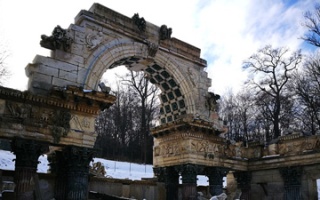
Schönbrunn Palace, the Roman Ruin and the Palm Tree Houses

Schönbrunn in winter - Palace and the Roman Ruin

06-02-2017 | Hits:439277

Schönbrunn - Once again, we were meeting to discuss the setting up of a camper ...

Karlsplatz, Karls Church and the MuseumsQuartier

Karlsplatz, Karls Church and the MuseumsQuartier

12-02-2017 | Hits:430827

Karlsplatz - The Viennese Karls Church, a Roman Catholic church in the 4th distr...

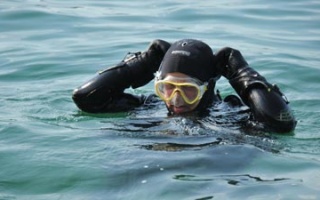
Diving at Blindsee in Tyrol - Austria

Diving at Blindsee in Tyrol - Austria

29-09-2022 | Hits:18944

Not just because of the wonderful summer weather, the next diving expedition is ...

Discover Vienna by bicycle - from Camping Neue Donau

Discover Vienna by bicycle - from Camping Neue Donau

31-07-2017 | Hits:662104

Like in Bremen (we have reported) and many other cities, cycling in Vienna has ...

News

Travelling

Culture

History

Life | Outdoors